
How Corrosion Mechanisms Evolve Over the Life of a Pipeline
Correctly identifying internal corrosion mechanisms is one of the most critical steps in pipeline integrity management—and one of the most frequently mishandled. Too often, corrosion is treated as a generic phenomenon, leading to mitigation strategies that are ineffective, misapplied, or counterproductive.
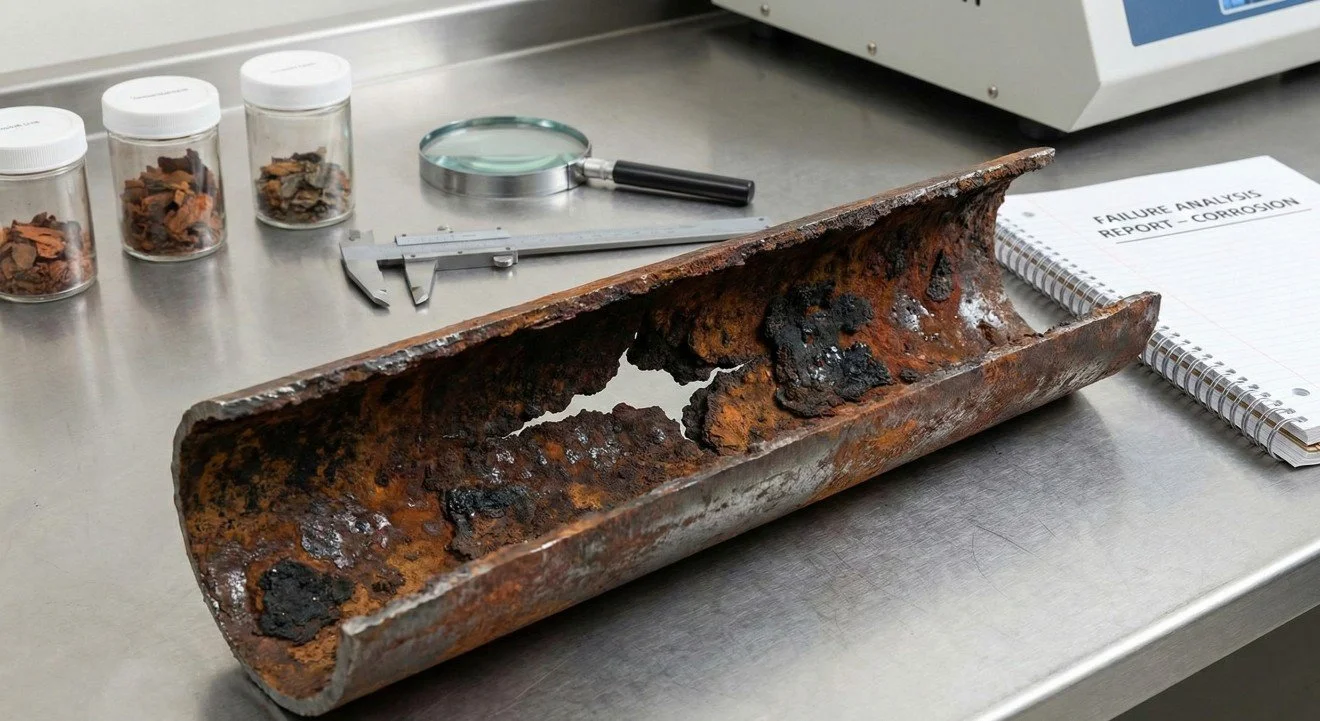
Evolution of corrosion mechanisms
Industry experience shows that most recurring corrosion failures are not caused by unknown mechanisms, but by incorrectly identified ones. This article explains how internal corrosion mechanisms should be identified in pipelines and why this identification is fundamental to sound integrity decisions.
Corrosion mechanism identification is not about labels
Labeling corrosion as “CO₂ corrosion”, “MIC”, or “erosion-corrosion” is not sufficient. Correct identification requires understanding:
why corrosion occurs,
where it develops,
how it propagates over time.
This principle is consistent with API RP 571, which explicitly links damage mechanisms to operating environment, exposure conditions, and morphology rather than to simple nomenclature.
Start with the operating context
Internal corrosion mechanisms are driven first and foremost by operating conditions. Before analyzing inspection data, the following parameters must be reviewed:
presence and behavior of free water,
fluid composition (CO₂, H₂S, oxygen, solids),
flow regime and velocity,
temperature and pressure profiles,
transient operations (start-up, shutdown, pigging).
Standards such as ISO 13623 require that internal corrosion threats be identified based on actual operating conditions, not solely on design assumptions.
Ignoring operating context is one of the most common causes of corrosion misidentification.
Use corrosion location as a primary diagnostic indicator
The spatial distribution of corrosion provides immediate clues about the underlying mechanism:
6 o’clock position: commonly associated with CO₂ corrosion, under-deposit corrosion, or MIC in the presence of free water.
Top-of-line corrosion: often linked to condensation in wet gas systems.
Downstream of fittings or valves: frequently indicative of erosion–corrosion.
This diagnostic approach aligns with the damage mechanism descriptions in API RP 571, which correlate corrosion location with environmental and flow-related drivers.
Corrosion morphology matters more than corrosion rate
Corrosion morphology is one of the most reliable indicators of mechanism:
uniform wall thinning suggests general corrosion,
deep pits or clustered attack indicate localized mechanisms such as MIC or under-deposit corrosion,
grooving or directional attack points to erosion–corrosion,
cracking patterns suggest hydrogen-related or stress-assisted mechanisms.
Fitness-for-service methodologies such as API RP 579 / ASME FFS-1 explicitly distinguish between uniform and localized corrosion because each morphology implies different failure behavior and mitigation strategies.
Distinguish corrosion from erosion and erosion–corrosion
One of the most frequent misclassifications is confusing corrosion with erosion or erosion–corrosion.
Key distinctions include:
corrosion requires free water and electrochemical reactions,
pure erosion is mechanical and does not require corrosive species,
erosion–corrosion results from synergy between corrosion and mechanical removal of protective films.
Misidentifying erosion–corrosion as pure corrosion often leads to excessive chemical treatment while leaving the real hydrodynamic driver unchanged.
Inspection data must be interpreted, not consumed
Inspection technologies (ILI, UT, visual inspection) provide measurements, not conclusions. Correct mechanism identification requires combining inspection data with:
operating history,
corrosion morphology,
fluid and deposit analysis,
pigging and monitoring feedback.
Standards such as DNV-RP-F101 emphasize that inspection results must be interpreted in the context of degradation mechanisms and defect characteristics, not treated as standalone indicators.
Why incorrect identification leads to repeated failures
When the wrong corrosion mechanism is assumed:
mitigation targets the wrong drivers,
corrosion continues or accelerates,
inspection intervals become non-conservative,
confidence in integrity management erodes.
For example, treating MIC as CO₂ corrosion may reduce average corrosion rates while allowing localized attack to progress unchecked.
Implications for pipeline integrity management
Correct identification of internal corrosion mechanisms directly impacts:
material selection and upgrade decisions,
corrosion monitoring strategy,
pigging and cleaning philosophy,
inspection technology and frequency,
fitness-for-service and remaining life assessments.
Mechanism identification is therefore a decision-support activity, not an academic exercise.
Conclusion
Internal corrosion mechanisms cannot be identified by corrosion rate alone.
They must be diagnosed through operating context, spatial distribution, and corrosion morphology.
Pipelines rarely fail because corrosion was unknown.
They fail because the wrong mechanism was assumed, leading to ineffective integrity decisions.
Correctly identifying corrosion mechanisms is one of the most powerful, and most underestimated, levers in pipeline integrity management.