
Why Many Pipeline Integrity Management Systems Fail Despite Being Fully Documented
In many oil and gas organizations, Pipeline Integrity Management Systems (PIMS) are extensively documented. Procedures exist, roles are defined, inspection plans are approved, and audits confirm compliance. Yet, pipeline failures continue to occur in assets operating under “fully implemented” integrity systems.
This apparent contradiction highlights a critical reality: documentation does not equal integrity management. This article explains why many PIMS fail despite being fully documented, and what truly differentiates effective integrity systems from paper-based ones.
Why Corrosion Prediction Models Must Be Treated with Caution
Corrosion prediction models are widely used in oil and gas projects to estimate corrosion rates, define corrosion allowance, and support integrity strategies. They are attractive because they provide numerical outputs that appear objective and reassuring.
However, corrosion prediction models are frequently misused and over-trusted, leading to underestimated risks and inappropriate integrity decisions. Many pipeline failures occur in systems where corrosion models were available, validated, and apparently conservative.
This article explains why corrosion prediction models must be treated with caution and how they should be used appropriately within pipeline integrity management.
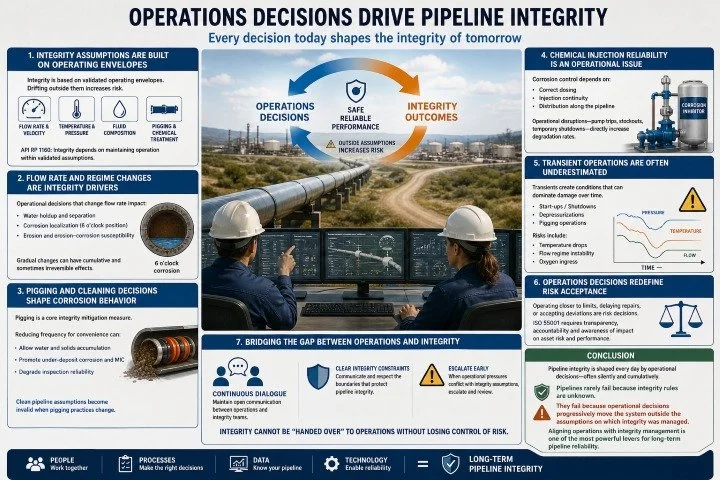
How Operations Decisions Directly Influence Long-Term Pipeline Integrity
Pipeline integrity is often perceived as an engineering or inspection-driven discipline. In reality, day-to-day operational decisions are among the strongest drivers of long-term pipeline integrity.
Many integrity failures originate not from design flaws, but from operational practices that progressively invalidate corrosion, erosion, or fitness-for-service assumptions. This article explains how operations decisions directly influence pipeline integrity and why integrity management must be tightly coupled with operations.
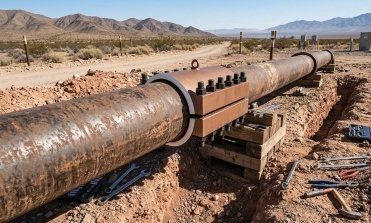
How Operating Parameters Drive Corrosion More Than Material Selection
This article explains why operating parameters dominate corrosion behavior and why integrity management must prioritize operational control over material upgrades.

Why Acquired Pipelines Represent a Major Integrity Risk
Acquiring existing pipelines is common in oil and gas operations, whether through asset transfers, field divestments, or mergers. These pipelines are often assumed to be fit for service because they are already in operation. This assumption is one of the most common and most dangerous integrity misconceptions.
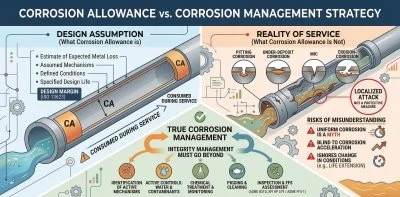
Why Corrosion Allowance Alone Is Not a Corrosion Management Strategy
This article explains why corrosion allowance alone is insufficient to manage corrosion risk and how integrity management must go beyond thickness margins.
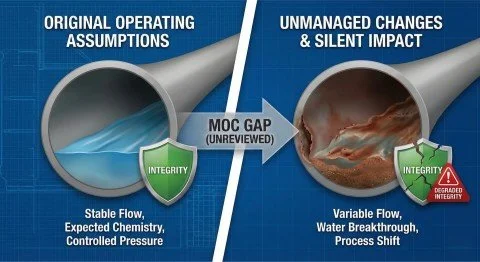
How Management of Change Silently Impacts Pipeline Integrity
Many pipeline failures do not result from design flaws or inspection gaps, but from unmanaged changes that progressively invalidate integrity assumptions. This article explains how Management of Change silently impacts pipeline integrity and why weak MOC processes are a recurring root cause of integrity failures.
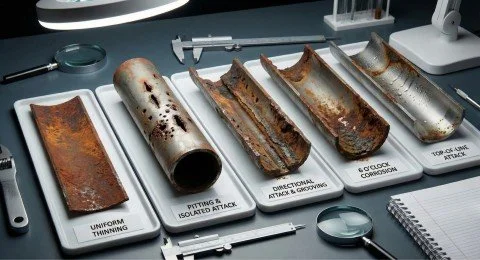
How Corrosion Morphology Helps Identify the Root Cause
While sizing defects is important, corrosion morphology is frequently the most powerful indicator of the underlying degradation mechanism. This article explains how corrosion morphology can be used as a diagnostic tool in pipeline integrity management and why it is essential for effective root cause analysis.
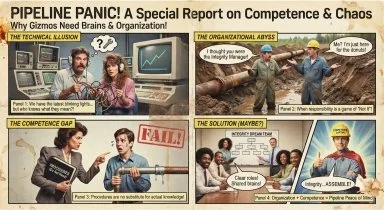
Why Competence and Organization Are Critical Elements of PIMS
Industry experience consistently shows that integrity systems fail not because tools are missing, but because people, roles, and decision processes are inadequately defined. This article explains why competence and organization are critical elements of effective pipeline integrity management.
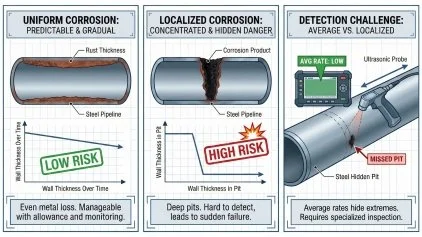
Why Uniform Corrosion Is Often Less Dangerous Than Localized Corrosion
This approach overlooks a critical reality: uniform corrosion is often far less dangerous than localized corrosion, even when average corrosion rates appear low. Most catastrophic pipeline failures are driven by localized damage mechanisms that escape conventional corrosion indicators.
This article explains why localized corrosion represents a much higher integrity threat than uniform corrosion and how integrity management must adapt accordingly.
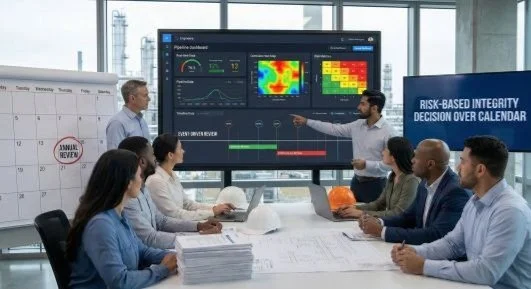
How Often Should a Pipeline Integrity Review Really Be Performed?
In practice, some high-risk pipelines require more frequent reviews, while stable systems may not benefit from rigid calendar-driven cycles. The real question is not “How often?” but “Under which conditions should an integrity review be performed?”
This article explains how integrity review frequency should be determined and why a risk-based approach is essential.

Why Corrosion Rates Are Often Underestimated During Early Field Life
Many corrosion-related failures originate from mechanisms initiated during early field life but detected much later. This article explains why corrosion rates are frequently underestimated during early operation and how this underestimation compromises long-term pipeline integrity.
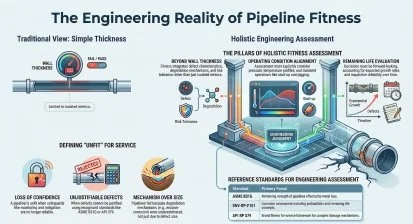
What Makes a Pipeline Fit for Continued Operation?
Determining whether a pipeline is fit for continued operation is one of the most critical decisions in pipeline integrity management. Yet, this decision is often oversimplified and reduced to a single question: “Is the remaining wall thickness acceptable?”
Fitness for continued operation is not a thickness criterion. It is a multidimensional engineering judgment that integrates defect characteristics, degradation mechanisms, operating conditions, and risk tolerance.
This article explains what truly makes a pipeline fit (or unfit) for continued operation, and why relying on isolated inspection metrics leads to unsafe decisions.
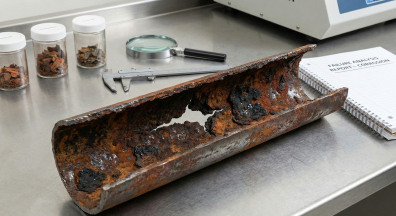
How Corrosion Mechanisms Evolve Over the Life of a Pipeline
Industry experience shows that most recurring corrosion failures are not caused by unknown mechanisms, but by incorrectly identified ones. This article explains how internal corrosion mechanisms should be identified in pipelines and why this identification is fundamental to sound integrity decisions.
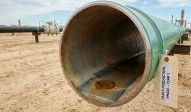
Why Corrosion Rates Are Often Underestimated During Early Field Life
Industry experience shows many corrosion-related failures originate from mechanisms initiated during early field life but detected much later. This article explains why corrosion rates are frequently underestimated during early operation and how this underestimation compromises long-term pipeline integrity.
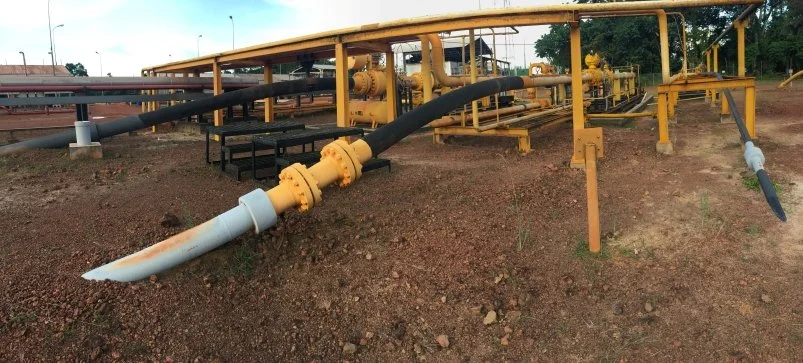
How to Define Pipeline System Limits in an Integrated Upstream–Downstream Environment
Defining pipeline system limits is one of the most underestimated steps in pipeline integrity management. In integrated upstream–downstream environments, pipelines rarely operate as isolated assets. They are connected to wells, processing facilities, platforms, storage systems, and utilities, often managed by different teams or even different entities.
Poorly defined system limits are a recurring root cause of integrity gaps, missed inspection scopes, unclear responsibilities, and inconsistent operating practices. This article explains how pipeline system limits should be defined and why this definition is fundamental to effective integrity management.
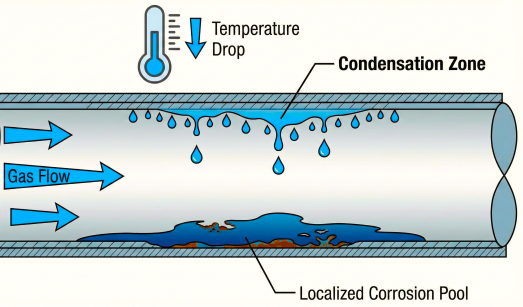
How Gas Condensation Leads to Unexpected Internal Corrosion
This article explains how gas condensation occurs in pipelines, why it leads to aggressive internal corrosion, and how integrity management programs often fail to anticipate this mechanism.
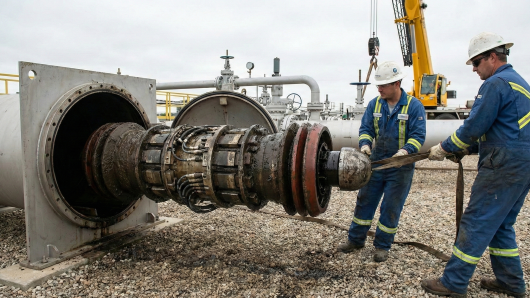
Why Pipeline Integrity Cannot Be Managed Only Through ILI and Leak Detection
In-line inspection (ILI) tools and leak detection systems are often perceived as the backbone of pipeline integrity management. Many operators assume that as long as pipelines are regularly inspected and equipped with leak detection, integrity risks are adequately controlled.
Industry experience shows the opposite: a significant number of pipeline failures occur in systems that were inspected and monitored. The issue is not the lack of technology, but the misconception that inspection and detection alone are sufficient to manage integrity.
This article explains why pipeline integrity cannot be reduced to ILI and leak detection, and why integrity management must be approached as a broader, risk-based process.
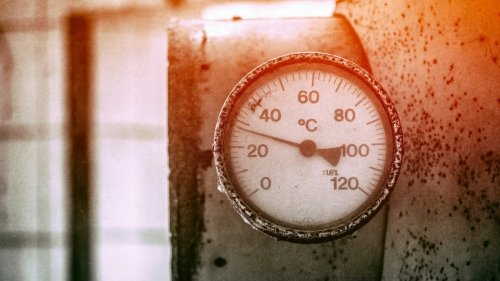
How Temperature Influences CO₂ Corrosion in Unexpected Ways
This article explains how temperature influences CO₂ corrosion in sometimes counterintuitive ways, and why integrity engineers must treat temperature as a regime-shaping parameter, not a simple multiplier.
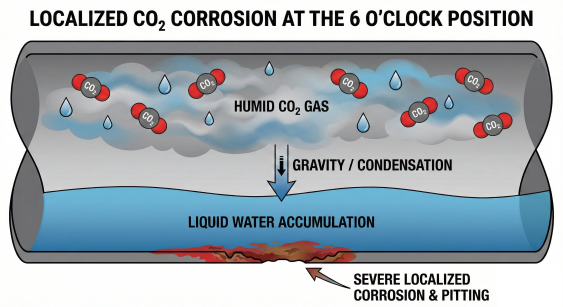
Why CO₂ Corrosion Often Concentrates at the 6 o’clock Position in Pipelines
This article explains why CO₂ corrosion preferentially develops at the 6 o’clock position and why this localization is often underestimated in integrity assessments.