
Why Corrosion Prediction Models Must Be Treated with Caution
Corrosion prediction models are widely used in oil and gas projects to estimate corrosion rates, define corrosion allowance, and support integrity strategies. They are attractive because they provide numerical outputs that appear objective and reassuring.
However, corrosion prediction models are frequently misused and over-trusted, leading to underestimated risks and inappropriate integrity decisions. Many pipeline failures occur in systems where corrosion models were available, validated, and apparently conservative.
This article explains why corrosion prediction models must be treated with caution and how they should be used appropriately within pipeline integrity management.
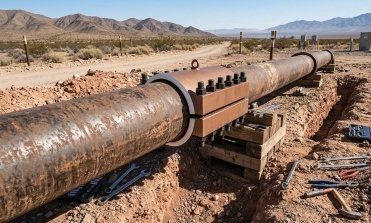
How Operating Parameters Drive Corrosion More Than Material Selection
This article explains why operating parameters dominate corrosion behavior and why integrity management must prioritize operational control over material upgrades.
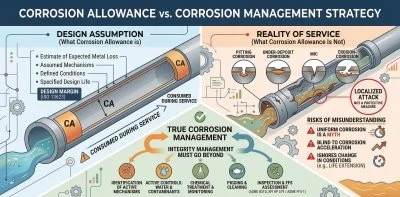
Why Corrosion Allowance Alone Is Not a Corrosion Management Strategy
This article explains why corrosion allowance alone is insufficient to manage corrosion risk and how integrity management must go beyond thickness margins.
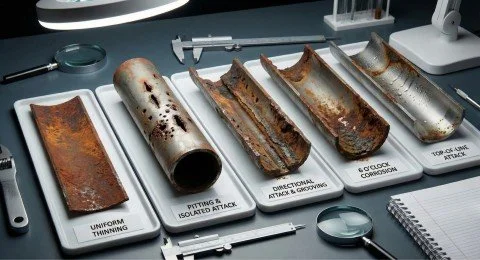
How Corrosion Morphology Helps Identify the Root Cause
While sizing defects is important, corrosion morphology is frequently the most powerful indicator of the underlying degradation mechanism. This article explains how corrosion morphology can be used as a diagnostic tool in pipeline integrity management and why it is essential for effective root cause analysis.
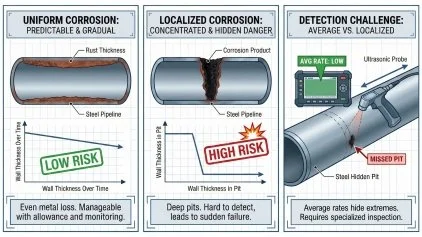
Why Uniform Corrosion Is Often Less Dangerous Than Localized Corrosion
This approach overlooks a critical reality: uniform corrosion is often far less dangerous than localized corrosion, even when average corrosion rates appear low. Most catastrophic pipeline failures are driven by localized damage mechanisms that escape conventional corrosion indicators.
This article explains why localized corrosion represents a much higher integrity threat than uniform corrosion and how integrity management must adapt accordingly.

Why Corrosion Rates Are Often Underestimated During Early Field Life
Many corrosion-related failures originate from mechanisms initiated during early field life but detected much later. This article explains why corrosion rates are frequently underestimated during early operation and how this underestimation compromises long-term pipeline integrity.
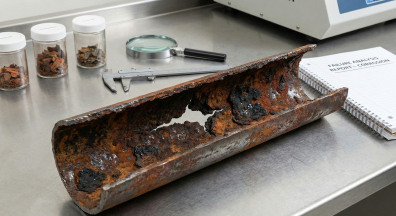
How Corrosion Mechanisms Evolve Over the Life of a Pipeline
Industry experience shows that most recurring corrosion failures are not caused by unknown mechanisms, but by incorrectly identified ones. This article explains how internal corrosion mechanisms should be identified in pipelines and why this identification is fundamental to sound integrity decisions.
Why Corrosion Rates Are Often Underestimated During Early Field Life
Industry experience shows many corrosion-related failures originate from mechanisms initiated during early field life but detected much later. This article explains why corrosion rates are frequently underestimated during early operation and how this underestimation compromises long-term pipeline integrity.
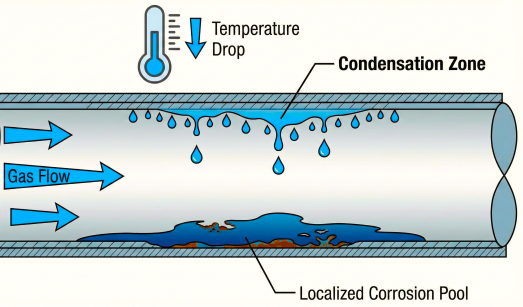
How Gas Condensation Leads to Unexpected Internal Corrosion
This article explains how gas condensation occurs in pipelines, why it leads to aggressive internal corrosion, and how integrity management programs often fail to anticipate this mechanism.
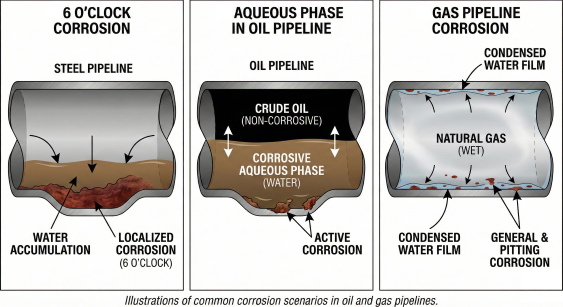
Why Pipelines Only Corrode When Free Water Is Present
One of the most fundamental principles of pipeline corrosion is also one of the most misunderstood: pipelines do not corrode without free water.
This article explains why free water is the true enabler of pipeline corrosion and why managing water is central to pipeline integrity management.
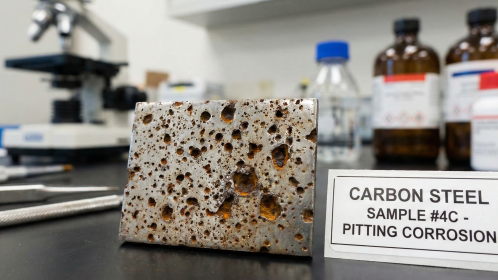
How to Correctly Identify Internal Corrosion Mechanisms in Pipelines
Correct identification of corrosion mechanisms is essential. Treating CO₂ corrosion as MIC, or erosion-corrosion as pure corrosion, leads to ineffective mitigation.