
Why CO₂ Partial Pressure Is the Key Parameter for Corrosion Assessment in Carbon Steel Pipelines
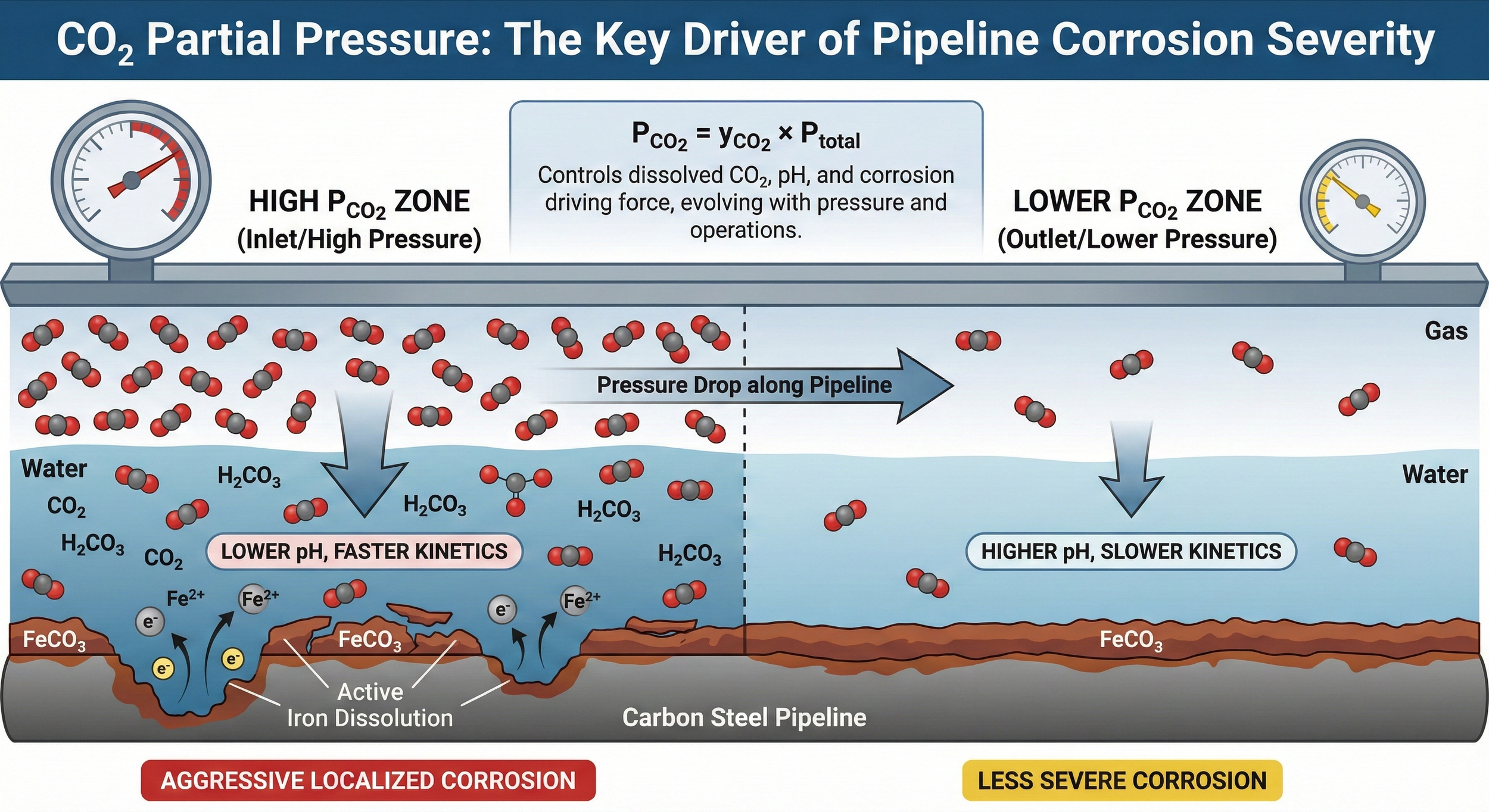
CO2 Partial Pressure
In CO₂ corrosion assessments, parameters such as CO₂ content, water cut, or pH are often discussed. However, the single most influential parameter controlling CO₂ corrosion severity in carbon steel pipelines is CO₂ partial pressure.
Misunderstanding or misusing CO₂ partial pressure leads to non-conservative corrosion predictions, inappropriate mitigation strategies, and false confidence in pipeline integrity, particularly in multiphase and evolving production systems.
This article explains why CO₂ partial pressure is the governing parameter for CO₂ corrosion and how it should be correctly used in integrity and maintenance decision-making.
CO₂ concentration is not the right metric
A frequent mistake is assessing corrosion risk based on CO₂ molar fraction or volume percentage in the gas phase.
From a corrosion standpoint, what matters is how much CO₂ dissolves into the aqueous phase. This is governed not by concentration alone, but by CO₂ partial pressure, defined as:
PCO₂ = yCO₂ × Ptotal
Two systems with identical CO₂ concentration can exhibit vastly different corrosion behavior if operating pressure differs.
This distinction is explicitly reflected in corrosion mechanism descriptions used in industry guidance such as API RP 571, where CO₂ corrosion severity is linked to partial pressure rather than bulk composition.
Why partial pressure controls corrosion chemistry
CO₂ partial pressure directly controls:
the amount of CO₂ dissolved in water,
carbonic acid (H₂CO₃) formation,
solution pH,
cathodic reaction kinetics.
Higher PCO₂ leads to:
lower pH,
increased iron dissolution rates,
higher corrosion driving force.
This electrochemical dependency explains why corrosion rates may increase even when water chemistry or flow conditions appear unchanged.
Partial pressure thresholds and corrosion regimes
From field experience and industry practice, CO₂ corrosion behavior changes with partial pressure:
Low PCO₂: corrosion rates may be limited, often underestimated
Moderate PCO₂: active CO₂ corrosion with potential FeCO₃ scale formation
High PCO₂: aggressive corrosion unless protective scales form and remain stable
Fitness-for-service and corrosion assessment approaches such as those referenced in DNV-RP-F101 implicitly assume that CO₂ corrosion severity scales with partial pressure when evaluating corrosion growth and remaining life.
Why partial pressure evolves during pipeline life
CO₂ partial pressure is not constant over the life of a pipeline. It evolves due to:
declining reservoir pressure,
changes in gas–liquid ratio,
pressure drops along the pipeline,
operational changes (compression, choking, rerouting).
As a result, corrosion risk may increase even as production declines, a counterintuitive but common late-life integrity issue.
This lifecycle perspective is consistent with ISO 13623, which requires reassessment of internal corrosion threats as operating conditions change.
Partial pressure and localized corrosion
CO₂ partial pressure influences not only corrosion rate, but also corrosion localization:
higher PCO₂ promotes rapid pit initiation,
localized breakdown of FeCO₃ scales becomes more likely,
bottom-of-line corrosion severity increases in stratified flow.
Average corrosion rates derived without accounting for local partial pressure variations can therefore be dangerously misleading.
Interaction with temperature and flow
Partial pressure alone does not act in isolation. Its impact is amplified or mitigated by:
temperature (affecting reaction kinetics and scale stability),
flow velocity and shear stress,
water chemistry and residence time.
This interaction explains why corrosion prediction models relying solely on PCO₂ often fail if operating reality is not correctly captured.
Integrity implications of misusing CO₂ partial pressure
Incorrect use of partial pressure leads to:
underestimated corrosion rates in early assessments,
delayed implementation of inhibition or pigging,
inappropriate inspection intervals,
non-conservative remaining life calculations.
Corrosion allowance and inspection strategies based on incorrect PCO₂ assumptions often become invalid within a few years of operation.
How integrity engineers should use CO₂ partial pressure
For effective integrity management, CO₂ partial pressure should be:
evaluated locally, not only at inlet conditions,
tracked as an evolving parameter,
integrated with water behavior and flow regime analysis,
reassessed following operational changes.
PCO₂ is a diagnostic and predictive parameter, not a static design input.
Conclusion
CO₂ corrosion in carbon steel pipelines is governed not by CO₂ content, but by CO₂ partial pressure and its evolution over time.
Pipelines rarely fail because CO₂ corrosion is unknown.
They fail because partial pressure was treated as a fixed value instead of a dynamic integrity driver.
Understanding and tracking CO₂ partial pressure is therefore a cornerstone of realistic corrosion assessment and long-term pipeline integrity.