
When Iron Carbonate (FeCO₃) Becomes Protective… and When It Does Not
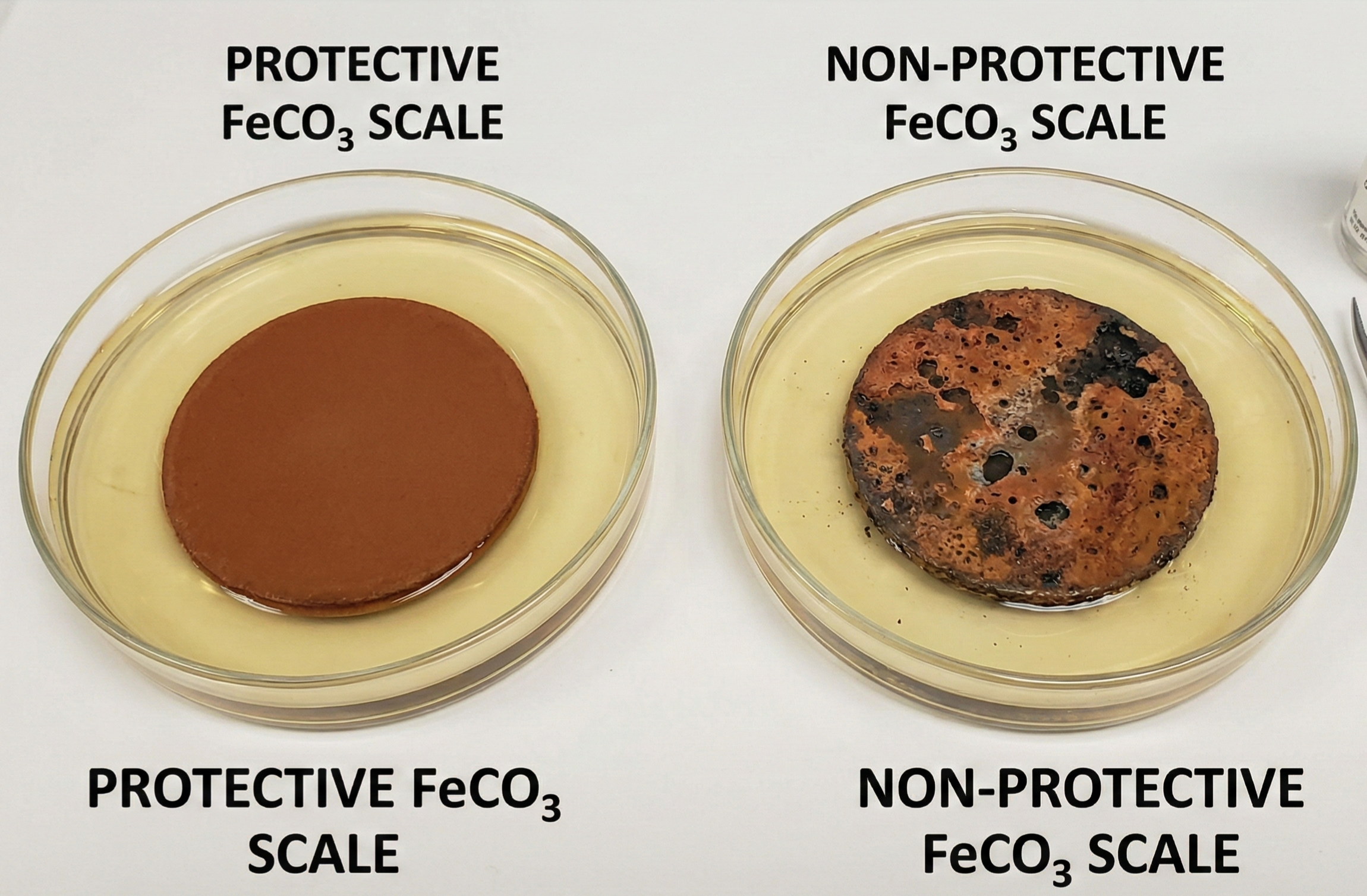
FeCO3 scale
In CO₂ corrosion discussions, iron carbonate (FeCO₃) is often presented as a naturally protective corrosion product capable of reducing corrosion rates in carbon steel pipelines. In practice, this assumption is one of the most common sources of false confidence in CO₂ corrosion management.
FeCO₃ can be protective, but only under very specific conditions. Outside these conditions, it offers little protection and may even contribute to localized corrosion. This article explains when iron carbonate becomes protective, when it does not, and why integrity assessments frequently overestimate its effectiveness.
What iron carbonate really is
Iron carbonate forms when dissolved iron reacts with carbonate ions in CO₂-containing aqueous environments:
Fe²⁺ + CO₃²⁻ → FeCO₃
Its formation depends on:
sufficient iron ion availability,
carbonate concentration (linked to CO₂ partial pressure),
temperature,
solution chemistry.
The mere presence of FeCO₃ does not guarantee protection.
This conditional nature of FeCO₃ formation is explicitly described in CO₂ corrosion mechanism references such as API RP 571, which distinguishes between scale formation and scale protectiveness.
Conditions required for FeCO₃ to become protective
For iron carbonate to act as a protective barrier, all of the following conditions must generally be met:
Sufficient temperature
FeCO₃ precipitation kinetics are slow at low temperature. Protective layers are more likely to form at elevated temperatures where precipitation is favored.Adequate CO₂ partial pressure
Partial pressure governs carbonate availability. Low PCO₂ environments may not sustain FeCO₃ formation.Low shear stress at the pipe wall
The scale must remain attached. High flow velocity, turbulence, or slug flow can continuously remove the layer.Relatively stable operating conditions
Protective films require time to develop and stabilize. Frequent transients disrupt scale growth.
Only when these conditions coexist does FeCO₃ reduce corrosion rates in a meaningful and sustained way.
Why FeCO₃ protection is often overestimated
In many pipelines, some FeCO₃ is detected and quickly interpreted as “protective scale present”. This conclusion is frequently wrong.
Common reasons include:
partial or patchy scale coverage,
mechanically weak or porous scales,
continuous removal by flow-induced shear,
breakdown during operational transients.
As a result, corrosion continues under or adjacent to the scale, often in a localized manner.
This behavior is implicitly recognized in DNV-RP-F101, which treats corrosion under scales and deposits as a localized threat rather than a mitigated condition.
Flow regime is often the dominant factor
From an integrity standpoint, flow regime often outweighs chemistry in determining FeCO₃ effectiveness.
In stratified or slug flow, FeCO₃ may form intermittently but is repeatedly removed.
At low points, detached scale can accumulate as deposits, promoting under-deposit corrosion.
In high-shear zones (elbows, fittings), FeCO₃ rarely survives.
This explains why FeCO₃-based protection is more reliable in laboratory conditions than in real pipelines.
The role of FeCO₃ in localized corrosion
Paradoxically, FeCO₃ can increase localization risk:
it shields underlying steel from inhibitors,
it creates differential aeration or chemistry cells,
it promotes pitting beneath partially detached scales.
Localized corrosion under FeCO₃ scales is a well-documented field phenomenon and one of the main reasons why average corrosion rates become misleading in CO₂ systems.
Why FeCO₃ does not eliminate the need for inhibitors
Even when FeCO₃ appears stable, it should not be treated as a primary mitigation measure.
Standards and industry practices reflected in ISO 13623 treat internal corrosion control as a combination of:
material selection,
operating control,
chemical inhibition,
inspection and monitoring.
FeCO₃ is a by-product of corrosion, not a corrosion control strategy.
Integrity implications of relying on FeCO₃
Assuming FeCO₃ protection without validation leads to:
underestimated corrosion rates,
extended inspection intervals without justification,
delayed inhibitor optimization,
unexpected localized failures.
Integrity management must therefore challenge FeCO₃ assumptions, particularly when operating conditions evolve.
How integrity engineers should assess FeCO₃ protection
A realistic assessment should include:
confirmation of scale continuity and adherence,
evaluation of flow regime and shear stress,
review of operational stability and transients,
correlation with localized corrosion evidence from inspections.
FeCO₃ protection must be demonstrated, not assumed.
Conclusion
Iron carbonate can reduce CO₂ corrosion—but only under restrictive and often unstable conditions.
Pipelines rarely fail because FeCO₃ does not form.
They fail because FeCO₃ was assumed to be protective when operating reality made this impossible.
For integrity engineers, FeCO₃ should be treated as a conditional modifier of corrosion behavior, not as a safeguard.