
How Operations Decisions Directly Influence Long-Term Pipeline Integrity
Pipeline integrity is often perceived as an engineering or inspection-driven discipline. In reality, day-to-day operational decisions are among the strongest drivers of long-term pipeline integrity.
Many integrity failures originate not from design flaws, but from operational practices that progressively invalidate corrosion, erosion, or fitness-for-service assumptions. This article explains how operations decisions directly influence pipeline integrity and why integrity management must be tightly coupled with operations.
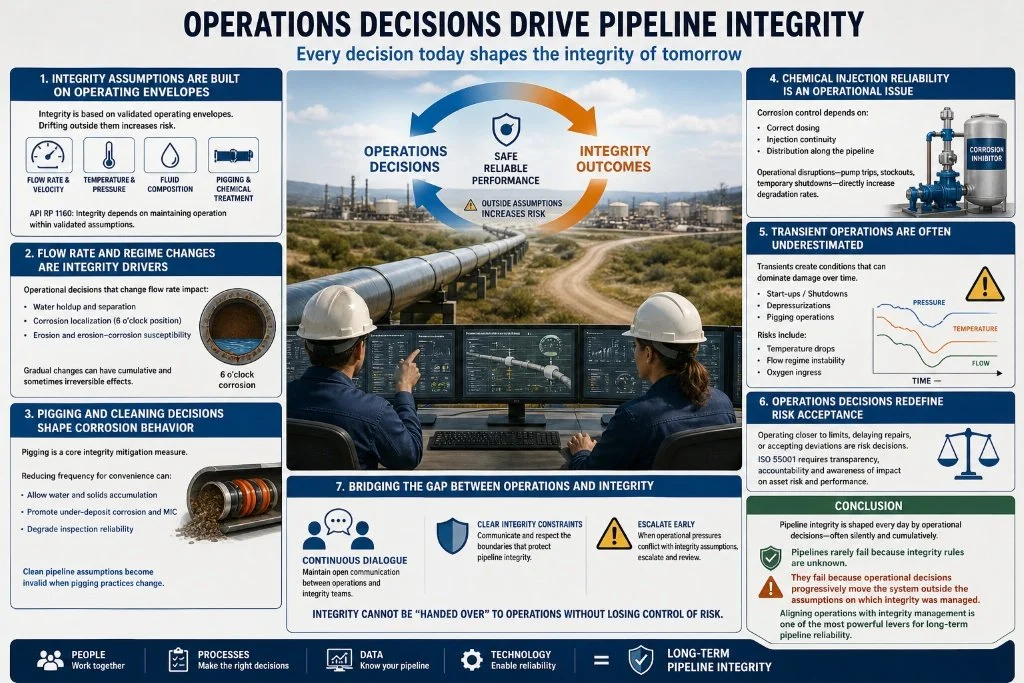
Operations impacts on Integrity
Integrity assumptions are built on operating envelopes
At design and early operation stages, pipeline integrity is managed based on defined operating envelopes:
flow rate and velocity ranges,
temperature and pressure limits,
expected fluid composition,
pigging and chemical treatment assumptions.
Standards such as API RP 1160 explicitly recognize that integrity management relies on maintaining operation within validated assumptions. When operations drift outside these envelopes, integrity risk increases—even if no immediate anomaly is detected.
Flow rate and regime changes are integrity drivers
Operational decisions affecting flow rate directly influence:
water holdup and separation,
corrosion localization at the 6 o’clock position,
erosion and erosion–corrosion susceptibility.
Gradual production changes often escape formal change processes, yet they have a cumulative and sometimes irreversible impact on degradation mechanisms.
Pigging and cleaning decisions shape corrosion behavior
Pigging frequency, pig selection, and cleaning effectiveness are typically treated as operational optimizations. From an integrity perspective, they are core mitigation measures.
Reducing pigging frequency for operational convenience can:
allow water and solids accumulation,
promote under-deposit corrosion and MIC,
degrade inspection reliability.
Integrity assumptions based on “clean pipeline” conditions rapidly become invalid when pigging practices change.
Chemical injection reliability is an operational issue
Corrosion inhibition and chemical treatment effectiveness depend on:
correct dosing,
injection continuity,
distribution along the pipeline.
Operational disruptions—pump trips, stockouts, temporary shutdowns—often go underreported from an integrity standpoint, yet they directly affect degradation rates.
This operational reality is explicitly addressed in integrity management guidance such as DNV-RP-F116, which emphasizes the need to consider operational reliability of safeguards when assessing integrity.
Transient operations are often underestimated
Start-ups, shutdowns, depressurizations, and pigging operations create transient conditions that differ significantly from steady-state operation:
temperature drops,
flow regime instability,
oxygen ingress risk.
While often treated as routine operations, these transients can dominate corrosion and erosion damage over time if not properly managed.
Operations decisions redefine risk acceptance
Choosing to operate closer to design limits, delaying repairs, or accepting temporary deviations are all risk acceptance decisions, whether formally recognized or not.
Standards such as ISO 55001 require that such decisions be made transparently, with clear accountability and awareness of their impact on asset risk and performance.
Bridging the gap between operations and integrity
Effective pipeline integrity management requires:
continuous dialogue between operations and integrity teams,
clear communication of integrity constraints,
escalation mechanisms when operational pressures conflict with integrity assumptions.
Integrity cannot be “handed over” to operations without losing control of risk.
Conclusion
Pipeline integrity is shaped every day by operational decisions—often silently and cumulatively.
Pipelines rarely fail because integrity rules are unknown.
They fail because operational decisions progressively move the system outside the assumptions on which integrity was managed.
Aligning operations with integrity management is therefore one of the most powerful levers for long-term pipeline reliability.