
How Operating Parameters Drive Corrosion More Than Material Selection
Material selection is often seen as the primary lever for controlling pipeline corrosion. When corrosion issues arise, the reflex is frequently to consider upgrading materials, from carbon steel to stainless steel or corrosion-resistant alloys.
In practice, operating parameters have a far greater influence on corrosion behavior than material selection alone. Many pipelines equipped with “better” materials still experience severe corrosion because operating conditions invalidate the assumptions behind material performance.
This article explains why operating parameters dominate corrosion behavior and why integrity management must prioritize operational control over material upgrades.
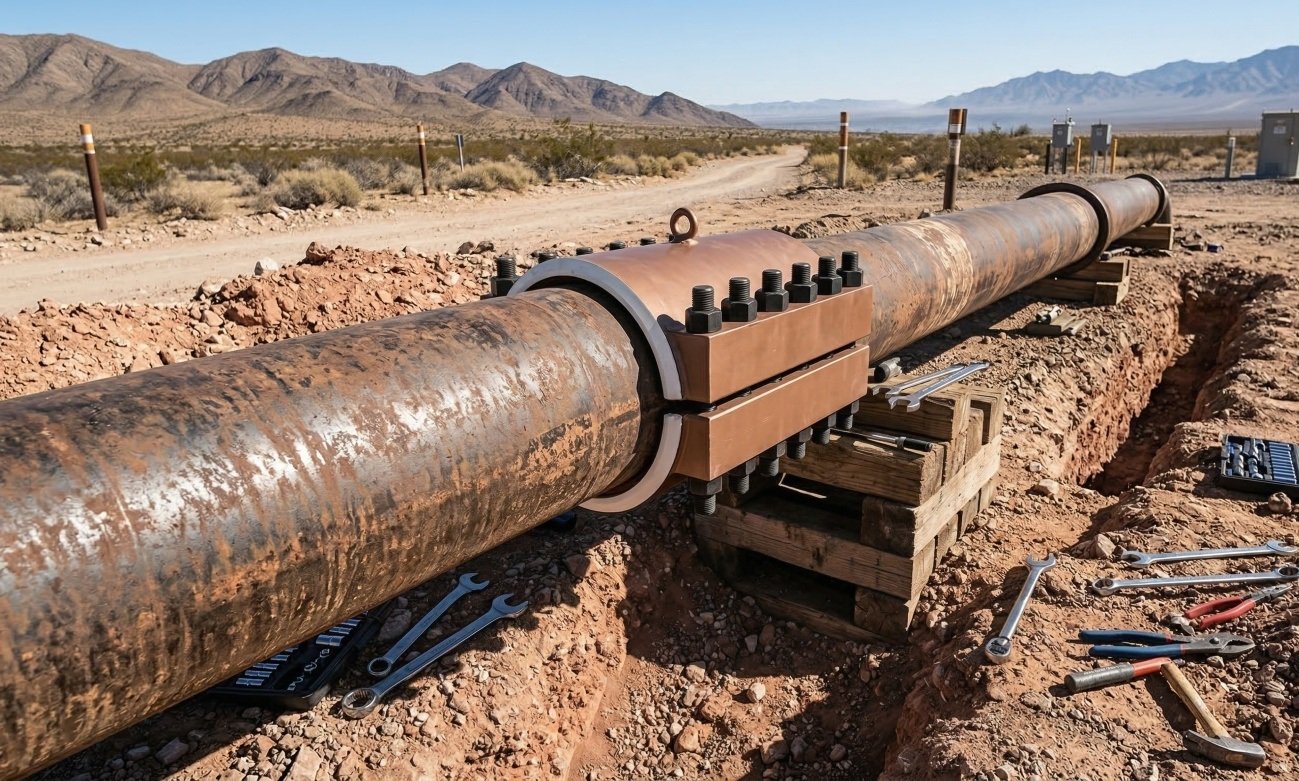
A repaired pipeline…
Pipeline materials are selected based on assumed conditions:
fluid composition,
temperature and pressure ranges,
flow regime,
corrosion control measures.
Standards such as ISO 13623 explicitly require that material selection be based on defined operating envelopes and internal corrosion threats. When actual operation deviates from these envelopes, material performance expectations no longer apply.
Regardless of material, free water governs internal corrosion:
where it accumulates,
how long it remains in contact with the pipe wall,
how aggressive its chemistry becomes.
Operating parameters such as flow velocity, inclination, and transient operation directly control water behavior. A corrosion-resistant material exposed to stagnant, acidic water may perform worse than carbon steel in well-managed flow conditions.
Flow regime is one of the strongest drivers of corrosion localization:
low velocities promote water dropout and MIC,
slug flow creates intermittent wetting and erosion–corrosion,
high local velocities increase shear stress and protective film removal.
Guidance such as DNV-RP-F101 recognizes that defect morphology and corrosion behavior are strongly influenced by flow conditions, reinforcing the need to integrate operating data into integrity assessments.
Temperature and pressure directly affect:
corrosion reaction kinetics,
solubility of corrosive gases (CO₂, H₂S),
stability of protective corrosion scales.
Small operational changes—compression, rerouting, or insulation modifications—can shift corrosion mechanisms even when material remains unchanged.
Corrosion inhibitors and other chemicals do not work in isolation. Their effectiveness depends on consistent injection, correct distribution and compatibility with flow regime. Operational interruptions, flow changes, or injection reliability issues often explain corrosion failures wrongly attributed to “material limitations”.
Corrosion-resistant materials are not corrosion-proof! Stainless steels and CRAs are sensitive to:
localized corrosion under deposits,
crevice conditions,
oxygen ingress,
chloride concentration.
Operating conditions that promote deposits, stagnation, or concentration effects can negate the expected benefits of higher-grade materials. This is implicitly addressed in ISO 15156, which frames material resistance as conditional on environmental severity rather than absolute.
Why material upgrades often disappoint. They fail to deliver expected integrity improvements when:
operating envelopes are not strictly controlled,
corrosion mechanisms are misidentified,
operations continue to drift over time.
In such cases, higher material cost buys only limited additional tolerance, not corrosion immunity.
Effective corrosion management prioritizes:
definition and enforcement of operating limits,
control of flow regime and water management,
alignment between operations and integrity assumptions,
reassessment of corrosion mechanisms when operating parameters change.
Material selection supports integrity, it does not replace operational discipline.
Pipelines corrode not because materials are inadequate, but because operating parameters dominate corrosion behavior. Upgrading materials without controlling operating conditions treats symptoms, not causes. Long-term pipeline integrity is achieved by managing how pipelines operate, not only what they are made of.