
Why Corrosion Rates Are Often Underestimated During Early Field Life
Why Corrosion Rates Are Often Underestimated During Early Field Life
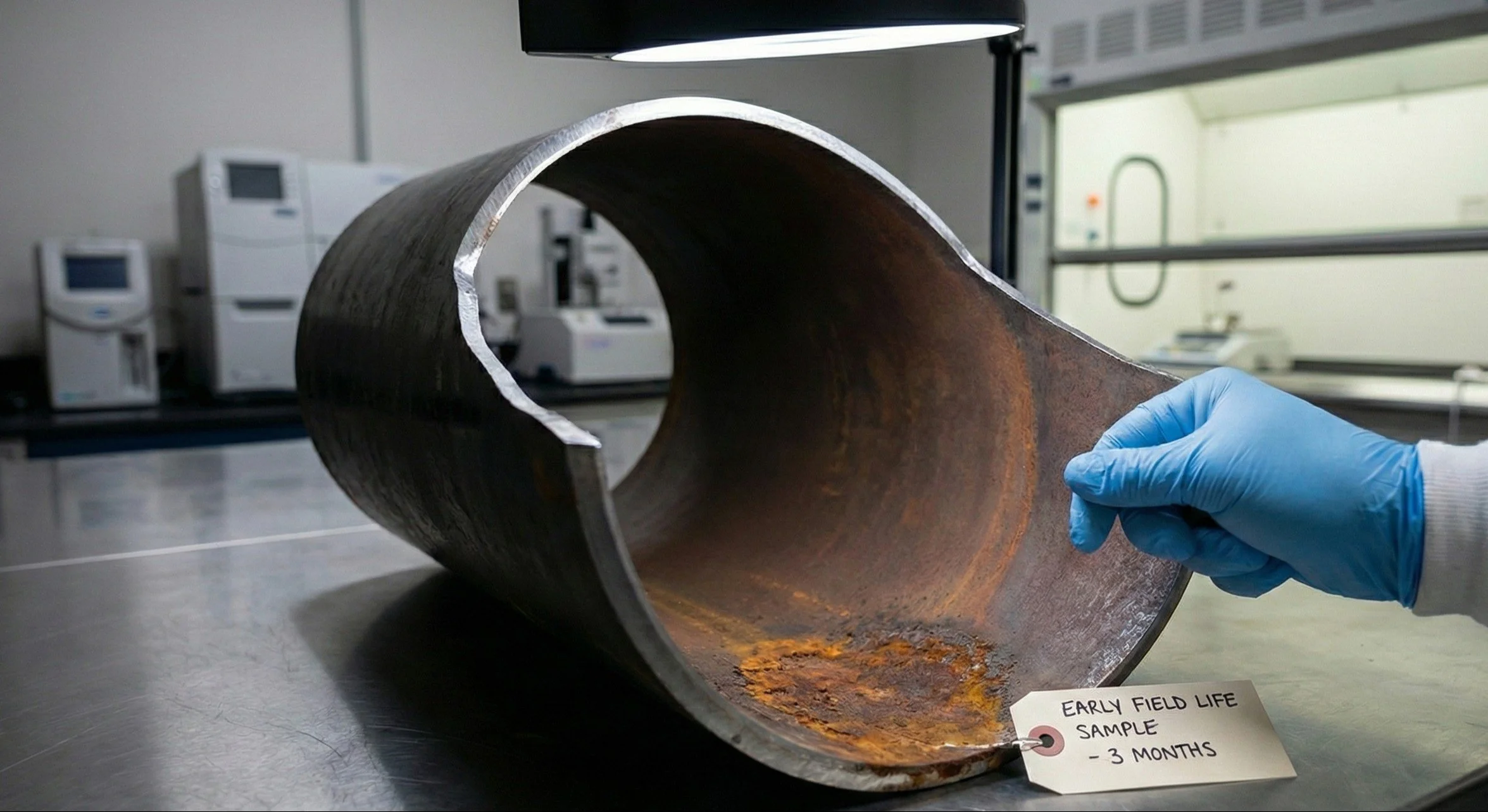
Early field life is commonly perceived as a low-risk period for pipeline integrity. Water cut is low, production is stable, inspection results are reassuring, and corrosion rates appear negligible. As a result, corrosion is often considered a future problem rather than an immediate integrity concern.
Industry experience shows the opposite: many corrosion-related failures originate from mechanisms initiated during early field life but detected much later. This article explains why corrosion rates are frequently underestimated during early operation and how this underestimation compromises long-term pipeline integrity.
Early field life creates a false sense of security
During early production, pipelines typically operate under conditions that appear favorable:
low or intermittent water production,
high flow velocities,
limited historical corrosion data,
clean internal surfaces.
These conditions often lead to the assumption that corrosion risk is minimal. However, corrosion mechanisms can already be active, even if their impact is not yet visible.
Low water cut does not mean low corrosion risk
One of the most common misconceptions is equating low water cut with low corrosion risk. In reality:
small amounts of free water are sufficient to initiate corrosion,
water may locally accumulate at low points or at the 6 o’clock position,
early corrosion may be highly localized and therefore invisible to average corrosion indicators.
Localized corrosion initiated early often governs future integrity risk.
Early operating conditions are often unstable
Early field life is rarely steady-state. It typically involves:
frequent start-ups and shutdowns,
production ramp-up and testing,
changing flow regimes,
evolving temperature and pressure profiles.
These transient conditions promote water dropout, intermittent wetting, and non-uniform corrosion, even when average conditions appear benign.
Corrosion monitoring is often not representative
In early life, corrosion monitoring programs are frequently limited or optimized for future steady-state operation. As a result:
monitoring locations may not coincide with early corrosion hot spots,
corrosion probes may remain dry while corrosion occurs elsewhere,
early localized damage goes undetected.
This creates a misleading picture of corrosion performance.
Why early corrosion is underestimated in models
Corrosion prediction models are usually calibrated for:
steady-state operation,
average fluid properties,
uniform wetting conditions.
They struggle to capture early-life realities such as transient flow, intermittent wetting, and evolving water chemistry. As a result, model-predicted corrosion rates during early life are often non-conservative.
This limitation is implicitly acknowledged in ISO 13623, which requires operators to reassess internal corrosion threats as operating conditions evolve rather than relying solely on initial design assumptions.
Early corrosion sets the stage for late-life failures
Corrosion initiated during early field life may:
create pits that later propagate rapidly,
damage protective films or coatings,
establish preferential corrosion sites that persist for years.
By the time corrosion becomes measurable at system level, the most critical damage may already be present.
Integrity implications of early-life underestimation
Underestimating early corrosion rates affects:
corrosion allowance consumption assumptions,
inspection intervals and coverage,
timing of mitigation measures,
confidence in long-term integrity.
Guidance such as API RP 1160 emphasizes that integrity management must consider how degradation mechanisms initiate and evolve over time, not only their mature behavior.
Managing early field life corrosion proactively
Effective integrity management during early field life requires:
conservative assumptions regarding water behavior,
early implementation of pigging and liquid management,
proactive corrosion monitoring and inspection,
rapid feedback between operations and integrity teams.
Treating early field life as a learning phase rather than a low-risk phase significantly improves long-term integrity outcomes.
Conclusion
Corrosion rarely starts when pipelines are old.
It often starts when pipelines are new, under conditions that appear safe but are in fact poorly understood.
Pipelines fail not because corrosion was ignored, but because early corrosion was underestimated and allowed to shape future degradation.
Recognizing early field life as a critical integrity phase is essential for sustainable pipeline operation.