
How Often Should a Pipeline Integrity Review Really Be Performed?
Many pipeline integrity programs define a fixed annual integrity review, often driven by internal procedures or regulatory expectations. While annual reviews are common, frequency alone does not guarantee effective integrity management.
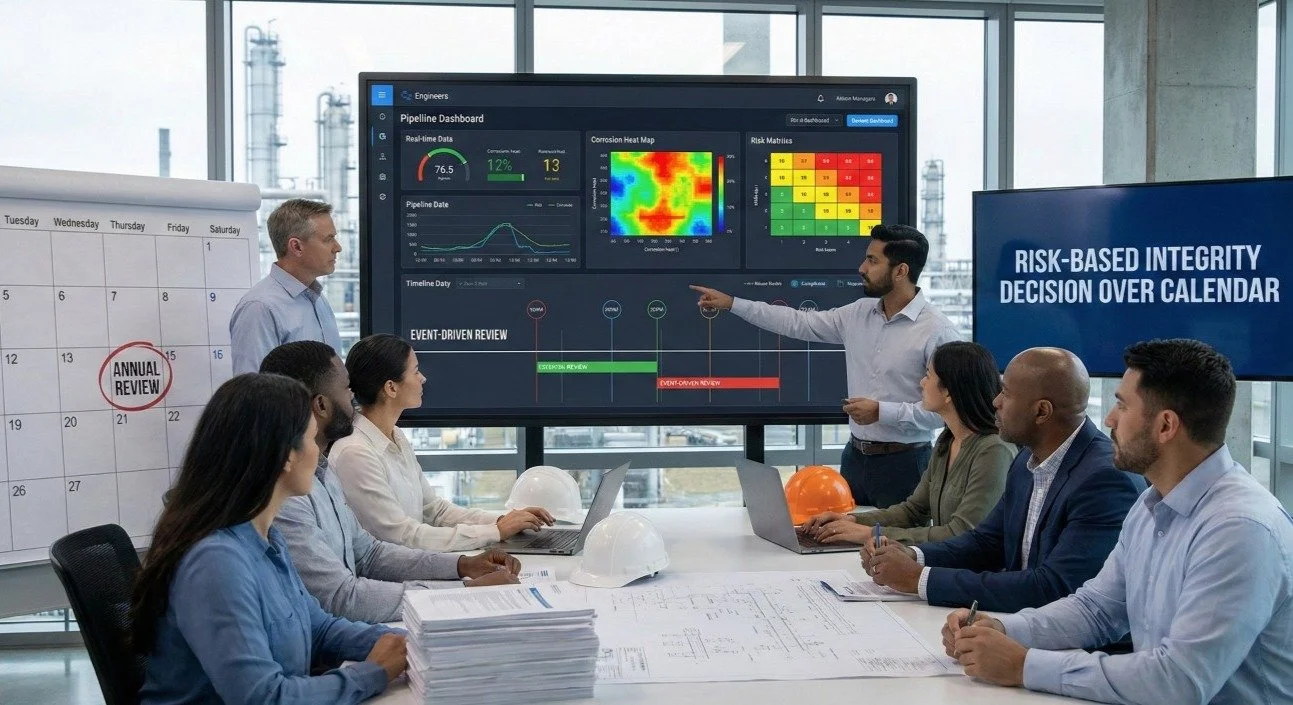
In practice, some high-risk pipelines require more frequent reviews, while stable systems may not benefit from rigid calendar-driven cycles. The real question is not “How often?” but “Under which conditions should an integrity review be performed?”
This article explains how integrity review frequency should be determined and why a risk-based approach is essential.
Integrity review
Integrity reviews are decision points, not reporting exercises
An integrity review is not a compilation of inspection results. It is a decision-making milestone where operators:
reassess integrity threats,
validate degradation assumptions,
confirm or revise operating envelopes,
define mitigation and inspection actions.
If no decisions result from the review, its frequency is irrelevant.
Why fixed review intervals are often misleading
Fixed annual reviews assume that degradation evolves linearly and predictably. This assumption is rarely valid.
Integrity threats can change rapidly due to:
water breakthrough,
changes in flow regime or production rates,
chemical treatment issues,
operational upsets or process modifications.
Under these conditions, waiting for the next scheduled review can significantly increase integrity risk.
Integrity review frequency must be risk-based
Review frequency should reflect:
the activity level of degradation mechanisms,
uncertainty in corrosion or crack growth rates,
inspection and monitoring coverage,
consequences of failure.
High-risk systems may justify quarterly or event-driven reviews, while stable systems with strong monitoring may require less frequent reassessment.
Event-driven reviews are as important as periodic reviews
In many cases, the most critical integrity reviews are triggered by events rather than time.
Typical triggers include:
significant changes in operating conditions,
inspection results indicating accelerated degradation,
loss or degradation of safeguards,
Management of Change (MOC) events.
Event-driven reviews ensure that integrity decisions remain aligned with actual operating reality.
What international standards actually say about review frequency
Only a limited number of standards explicitly address integrity review frequency and philosophy:
API RP 1160 states that integrity management activities, including reviews, shall be performed at intervals commensurate with risk and updated when operating conditions or threats change.
DNV-RP-F116 emphasizes continuous integrity assessment and requires reassessment following changes in threats, operating conditions, or inspection results.
ISO 55001 (Asset Management) requires periodic review of asset performance and risk, without prescribing fixed intervals, reinforcing a risk-based approach.
None of these standards mandate a rigid annual review cycle.
What a meaningful integrity review should include
Regardless of frequency, an integrity review should integrate:
inspection and monitoring results,
operating and process data,
incident and near-miss feedback,
assessment of mitigation effectiveness,
updated risk evaluation.
The depth of the review should scale with risk.
When integrity reviews become ineffective
Integrity reviews lose value when:
they repeat previous conclusions without reassessment,
they are disconnected from operations,
they are driven by compliance rather than decision-making,
actions are not tracked to closure.
In such cases, increasing review frequency only increases workload, not integrity.
Conclusion
There is no universal “right” frequency for pipeline integrity reviews. Effective integrity management relies on risk-based and event-driven reassessment, not on rigid calendars. Pipelines fail not because integrity reviews are infrequent, but because reviews are performed without regard to how risk actually evolves.