
Why Pipelines Only Corrode When Free Water Is Present
One of the most fundamental principles of pipeline corrosion is also one of the most misunderstood:
pipelines do not corrode without free water.
Hydrocarbons themselves(oil or dry gas) are not corrosive to carbon steel. Corrosion starts only when an aqueous phase is present and in direct contact with the pipe wall. Ignoring this principle leads to incorrect corrosion assessments, inappropriate mitigation strategies, and, ultimately, integrity failures.
This article explains why free water is the true enabler of pipeline corrosion and why managing water is central to pipeline integrity management.
Corrosion is an electrochemical process
Internal corrosion in pipelines is an electrochemical reaction that requires:
a metallic surface,
an electrolyte,
anodic and cathodic reactions.
In oil and gas pipelines, free water is the electrolyte. Without it, corrosive species such as CO₂, H₂S, or oxygen cannot participate in corrosion reactions, regardless of their concentration in the gas or oil phase.
Sources of free water in pipelines
Free water in pipelines can originate from multiple sources, including:
Produced water transported with hydrocarbons,
Condensation of water from the gas phase due to pressure and temperature drops,
Water dropout during transient operations,
Residual water following hydrotesting or commissioning.
Many pipelines assumed to be “dry” in design develop free water during operation, often unexpectedly.
Why small amounts of water matter
Even limited volumes of free water can cause severe corrosion when:
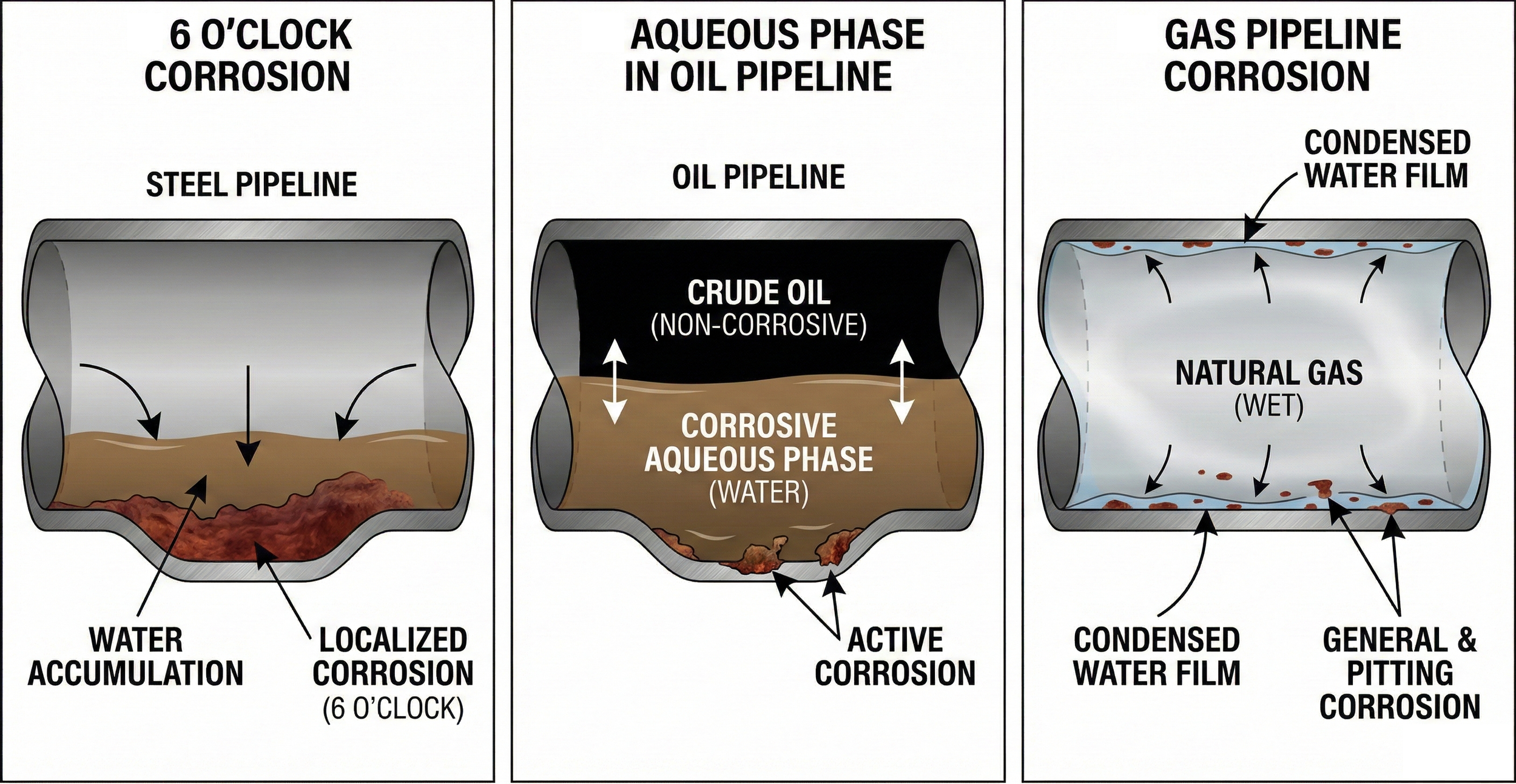
Water settles at the bottom of the line (6 o’clock position),
Flow velocity is insufficient to keep water dispersed,
Water chemistry is aggressive (low pH, dissolved gases, chlorides).
Localized corrosion initiated by thin water films or small water pools is responsible for many rapid pipeline failures.
The 6 o’clock corrosion phenomenon
In horizontal pipelines, gravity causes free water to accumulate at the bottom of the pipe. This creates:
A persistent electrolyte layer,
Preferential corrosion at the 6 o’clock position,
Localized metal loss difficult to detect by spot measurements.
This explains why corrosion damage is often found at the bottom of pipelines even when overall corrosion rates appear low.
Gas pipelines are not immune to corrosion
Gas pipelines are frequently assumed to be corrosion-free. In reality, gas cooling leads to water condensation, particularly in long pipelines, offshore export lines, and subsea systems.
Condensed water often contains dissolved CO₂ or H₂S and creates highly corrosive conditions at local low points, despite low average water content in the system.
Free water drives corrosion mechanism selection
The presence, chemistry, and behavior of free water determine:
Whether corrosion is uniform or localized,
The likelihood of MIC development,
The potential for erosion-corrosion,
The effectiveness of corrosion inhibitors.
Misjudging water behavior often results in selecting mitigation measures that do not address the real corrosion driver.
Implications for pipeline integrity management
Managing corrosion means managing water:
Identifying where water forms and accumulates,
Controlling water chemistry,
Ensuring effective pigging and drainage,
Adapting inspection and monitoring strategies.
Integrity programs that focus only on corrosion rates or inhibitor dosage, without understanding water behavior, systematically underestimate corrosion risk.
Conclusion
Pipelines corrode not because corrosive species are present, but because free water enables corrosion to occur.
Effective pipeline integrity management starts with understanding when, where, and how water appears in the system, and how its behavior evolves over time.