
Why Uniform Corrosion Is Often Less Dangerous Than Localized Corrosion
In pipeline integrity management, corrosion rate is often used as a primary indicator of integrity risk. Pipelines exhibiting low average corrosion rates are frequently considered safe, while higher rates trigger concern and mitigation.
This approach overlooks a critical reality: uniform corrosion is often far less dangerous than localized corrosion, even when average corrosion rates appear low. Most catastrophic pipeline failures are driven by localized damage mechanisms that escape conventional corrosion indicators.
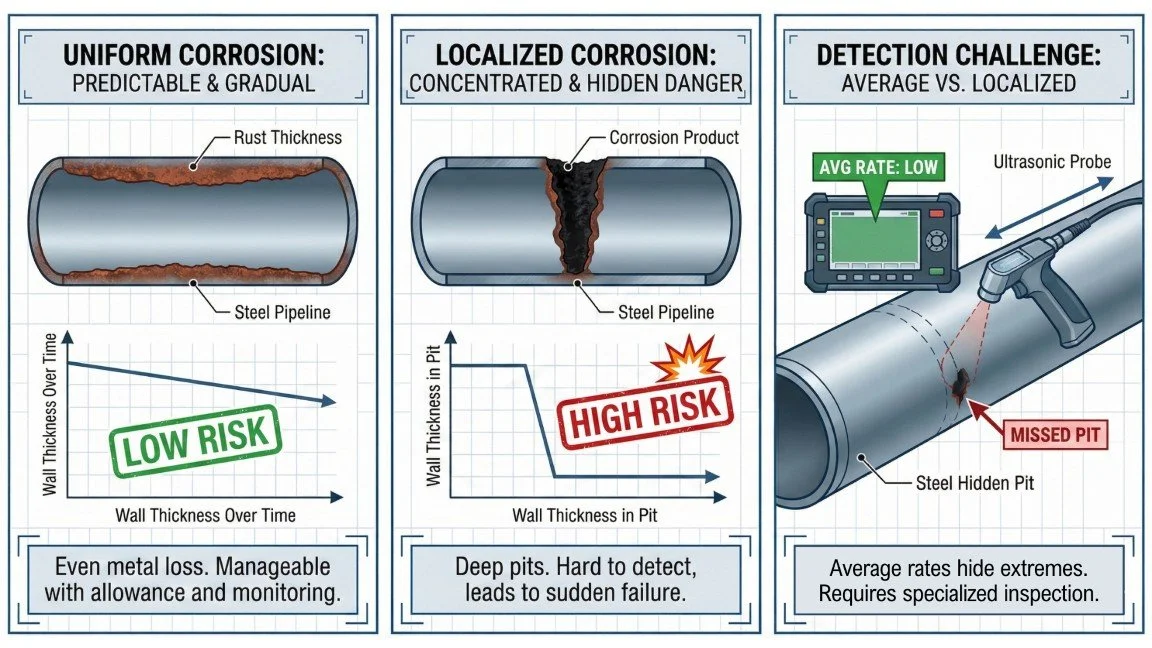
uniform vs localized corrosion
This article explains why localized corrosion represents a much higher integrity threat than uniform corrosion and how integrity management must adapt accordingly.
Uniform corrosion is predictable and manageable
Uniform corrosion affects large areas of the pipeline wall at relatively consistent rates. Its key characteristics are:
gradual and evenly distributed metal loss,
predictable wall thickness reduction,
compatibility with corrosion allowance concepts.
Because of its predictability, uniform corrosion can be effectively managed through:
design corrosion allowance,
inspection-based wall thickness monitoring,
conservative remaining life calculations.
Standards such as ASME B31G explicitly address uniform metal loss by providing methodologies to assess remaining strength based on generalized corrosion patterns.
Localized corrosion concentrates damage
Localized corrosion mechanism, including pitting, under-deposit corrosion, and microbiologically influenced corrosion (MIC), are fundamentally different.
They are characterized by:
highly concentrated metal loss,
small affected surface areas,
rapid penetration through the wall thickness,
poor correlation with average corrosion rates.
A pipeline with a low average corrosion rate may still fail suddenly due to a single deep pit.
Why localized corrosion is harder to detect
Localized corrosion presents several detection challenges:
spot ultrasonic measurements may miss narrow pits,
corrosion monitoring devices may not be located at attack sites,
ILI sizing uncertainty increases for small, deep features.
This is why localized corrosion often progresses unnoticed until advanced stages.
Guidance such as DNV-RP-F101 explicitly recognizes the limitations of inspection techniques when dealing with localized corrosion and emphasizes conservative assessment approaches.
Corrosion rate is a misleading indicator for localized damage
Average corrosion rates smooth out localized extremes. As a result:
early localized attack may remain invisible in corrosion KPIs,
mitigation may be delayed because “rates look acceptable”,
integrity decisions are based on incomplete risk perception.
Localized corrosion risk cannot be managed using average values alone.
Fitness-for-service is more sensitive to localized corrosion
From a fitness-for-service perspective, localized corrosion governs failure risk because:
remaining strength is controlled by the deepest defect,
localized metal loss creates stress concentration,
burst pressure may be dominated by a single feature.
Standards such as DNV-RP-F101 and API RP 579 / ASME FFS-1 explicitly distinguish between uniform corrosion and localized damage when assessing structural integrity.
Localized corrosion drives inspection strategy
Integrity programs must adapt inspection and monitoring strategies when localized corrosion is credible:
full-coverage inspection is preferred over spot measurements,
inspection intervals should reflect localization risk,
monitoring locations must target water accumulation and deposit zones.
Uniform corrosion assumptions in the presence of localized mechanisms are a common root cause of integrity failures.
Operational conditions promote localization
Localized corrosion is often promoted by:
free water accumulation at low points,
solids or deposits creating shielding effects,
low flow velocity or stagnant zones,
intermittent wetting and drying cycles.
These conditions are often operational rather than design-driven, reinforcing the need for close alignment between operations and integrity.
Conclusion
Uniform corrosion reduces pipeline life gradually and predictably. Localized corrosion threatens pipeline integrity suddenly and disproportionately.
Pipelines rarely fail because average corrosion rates were too high. They fail because localized corrosion was underestimated or treated as uniform.
Recognizing and managing corrosion localization is therefore one of the most critical aspects of pipeline integrity management.