
How Corrosion Morphology Helps Identify the Root Cause
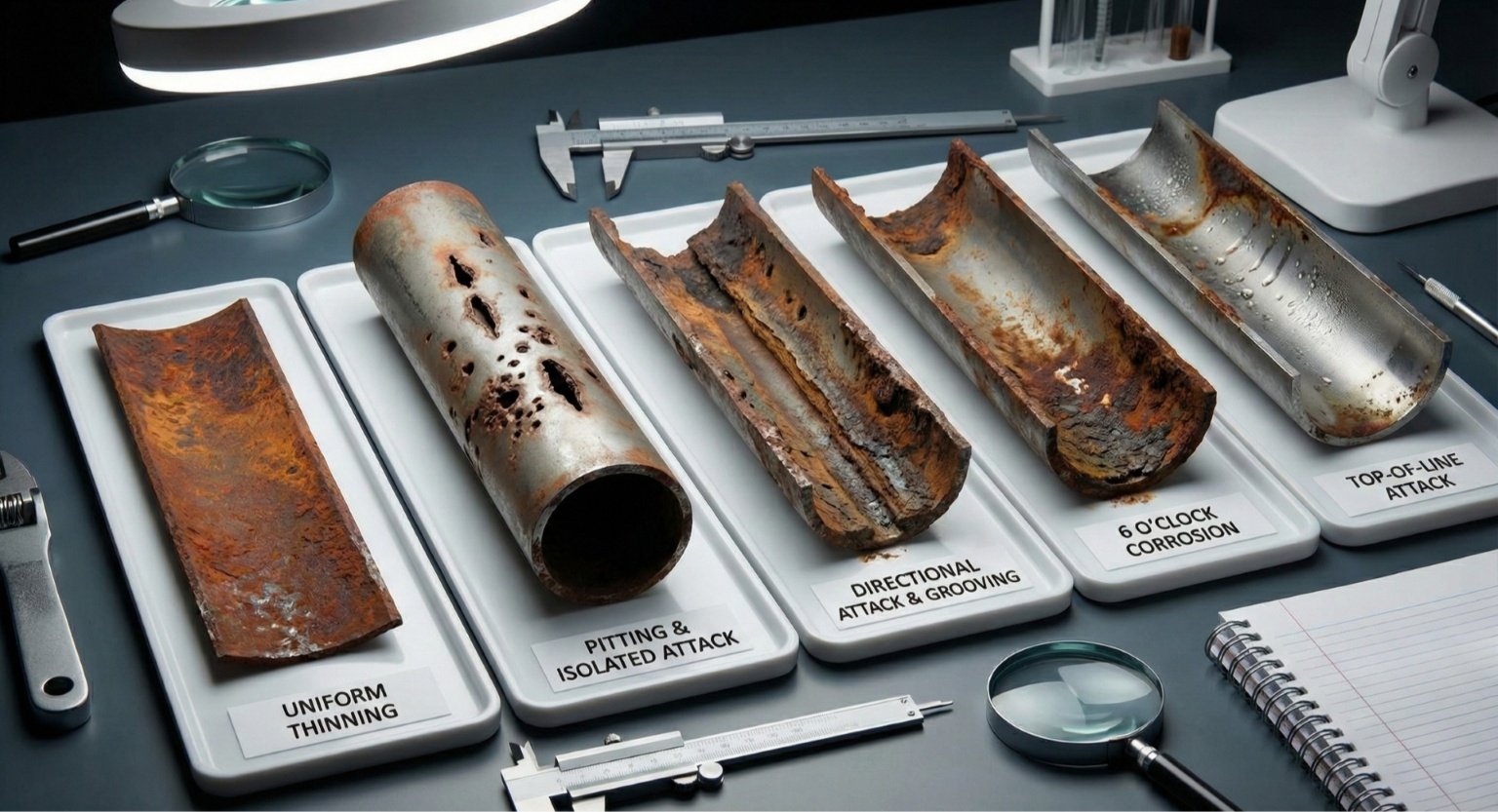
Corrosion morphologies
When corrosion is discovered in a pipeline, the first reaction is often to quantify metal loss and estimate remaining life. While sizing defects is important, corrosion morphology is frequently the most powerful indicator of the underlying degradation mechanism.
Ignoring corrosion morphology leads to misidentification of root causes, inappropriate mitigation measures, and repeated failures. This article explains how corrosion morphology can be used as a diagnostic tool in pipeline integrity management and why it is essential for effective root cause analysis.
Corrosion morphology is not cosmetic information
Corrosion morphology refers to the shape, distribution, and spatial characteristics of metal loss. It provides insight into:
how corrosion initiated,
how it propagated,
which environmental and operational factors are dominant.
Two corrosion features with identical depth may represent completely different integrity threats depending on their morphology.
Uniform thinning: indicators and implications
Uniform corrosion is characterized by:
widespread and relatively even wall thinning,
absence of sharp pits or preferential attack,
correlation with overall exposure to corrosive environments.
This morphology typically indicates:
stable corrosion mechanisms,
reasonably uniform wetting conditions,
predictable degradation rates.
Assessment methodologies such as ASME B31G are explicitly based on generalized metal loss geometries and are therefore applicable primarily to this type of morphology.
Pitting and isolated attack: early warning signs
Pitting corrosion appears as:
deep, narrow cavities,
isolated or clustered features,
high depth-to-area ratios.
This morphology is commonly associated with:
under-deposit corrosion,
microbiologically influenced corrosion (MIC),
oxygen ingress or intermittent wetting.
Because pits can rapidly penetrate wall thickness, pitting morphology represents a high integrity risk even when average corrosion rates are low.
Standards such as API RP 579 / ASME FFS-1 explicitly recognize localized corrosion morphologies and require specific assessment approaches distinct from uniform corrosion.
Directional attack and grooving
Directional corrosion features, such as grooves or preferential attack downstream of fittings, often indicate:
erosion–corrosion synergy,
high local shear stress,
disturbed flow regimes.
This morphology points directly to hydrodynamic drivers rather than purely chemical ones, guiding mitigation toward flow control or design changes rather than increased chemical treatment.
Guidance in DNV-RP-F101 acknowledges the influence of defect shape and orientation on integrity assessment and remaining strength calculations.
Circumferential distribution as a diagnostic tool
The circumferential position of corrosion provides strong clues:
6 o’clock corrosion suggests water accumulation or under-deposit mechanisms,
top-of-line attack may indicate condensation and wet gas corrosion,
random circumferential distribution may suggest internal chemistry-driven corrosion.
Mapping corrosion morphology spatially is often more informative than individual defect measurements.
Morphology reveals operational influence
Corrosion morphology often reflects operational history:
intermittent wetting produces banded attack,
prolonged low-flow operation promotes localized corrosion,
frequent transients create mixed morphologies.
These patterns are invaluable for reconstructing degradation history and identifying integrity-relevant operational practices.
Why morphology is essential for root cause analysis
Root cause analysis that ignores morphology tends to focus on generic causes (“corrosion”, “aggressive fluids”) rather than actionable drivers.
In contrast, morphology-based analysis allows integrity teams to:
distinguish between competing corrosion mechanisms,
identify dominant drivers,
select mitigation strategies that address the real cause rather than the symptom.
This approach is consistent with the philosophy of integrity management standards that emphasize understanding degradation mechanisms, not just defect dimensions.
Implications for inspection and integrity management
Recognizing corrosion morphology influences:
inspection technology selection,
inspection coverage and resolution requirements,
remaining life and fitness-for-service assessment,
prioritization of mitigation actions.
Treating all corrosion as equivalent regardless of morphology is one of the most common integrity management mistakes.
Conclusion
Corrosion morphology is one of the most reliable indicators of why a pipeline is degrading, not just how fast. Pipelines rarely fail because corrosion was detected too late. They fail because the morphology of corrosion was ignored, misinterpreted, or oversimplified. Integrating corrosion morphology into integrity decision-making is therefore essential for effective and sustainable pipeline integrity management.