
How Management of Change Silently Impacts Pipeline Integrity
Management of Change (MOC) is often perceived as an administrative or safety-related requirement. In pipeline integrity management, however, MOC is one of the most critical integrity barriers.
Many pipeline failures do not result from design flaws or inspection gaps, but from unmanaged changes that progressively invalidate integrity assumptions. This article explains how Management of Change silently impacts pipeline integrity and why weak MOC processes are a recurring root cause of integrity failures.
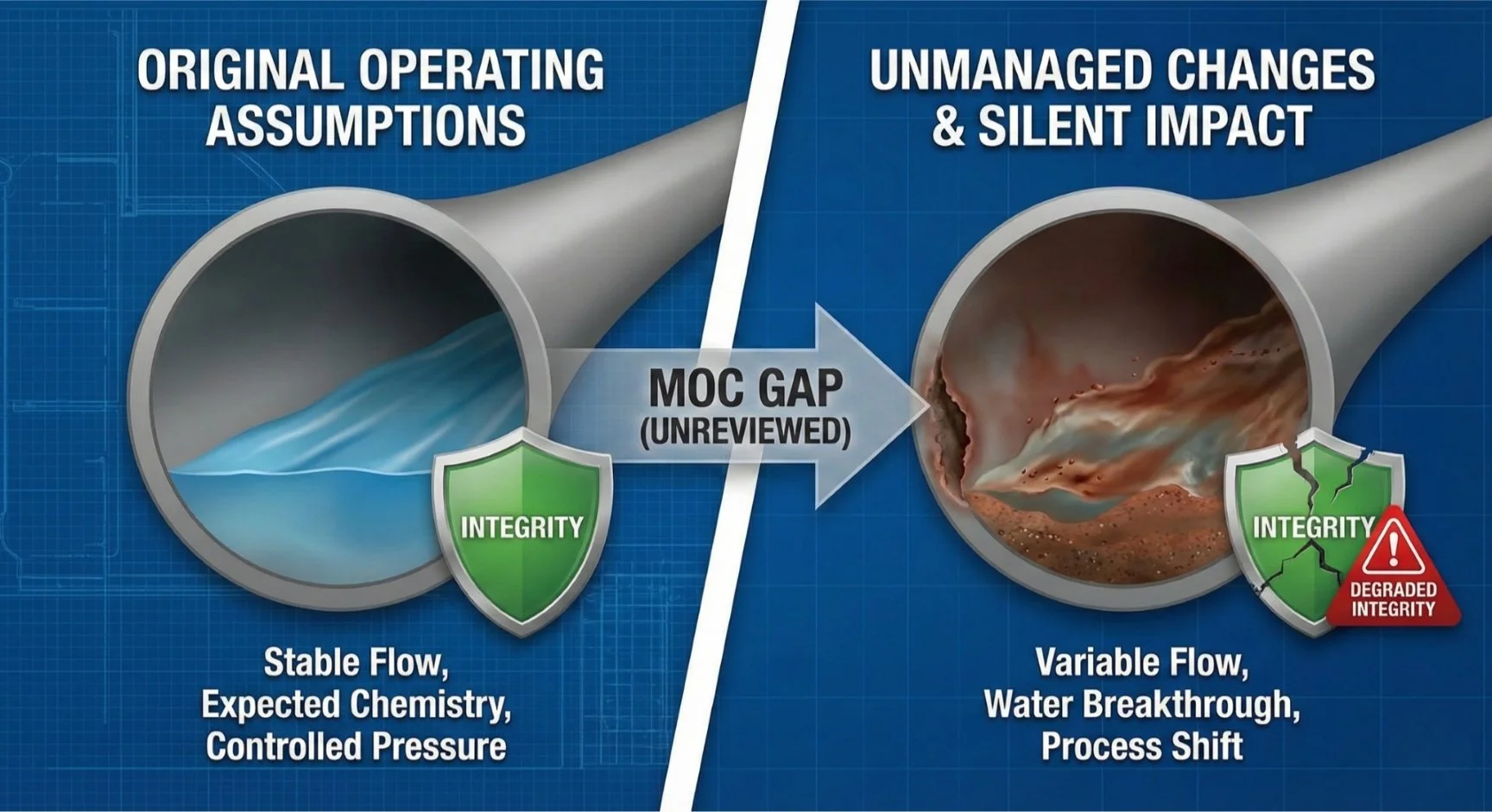
Management of change & Integrity
Integrity assumptions are conditional by nature
Pipeline integrity is managed based on assumptions made during design and operation:
expected fluid composition,
flow regime and velocity,
temperature and pressure envelopes,
corrosion and erosion mitigation strategies.
These assumptions are not permanent. Any change affecting them alters the integrity risk profile.
What qualifies as a change from an integrity perspective
From an integrity standpoint, changes extend far beyond physical modifications. Integrity-relevant changes include:
variations in flow rate or production profile,
water breakthrough or changes in fluid chemistry,
modifications to pigging, chemical injection, or operating procedures,
temporary operating modes or prolonged shutdowns.
When such changes bypass MOC, integrity degradation accelerates unnoticed.
Why unmanaged changes are particularly dangerous
Unmanaged changes rarely cause immediate failure. Instead, they:
shift corrosion or erosion mechanisms,
accelerate degradation rates,
invalidate inspection intervals and fitness-for-service assessments.
Because the impact is progressive, early warning signs are often missed until significant damage has occurred.
MOC links operations to integrity management
Effective MOC ensures that:
integrity engineers are involved in change evaluation,
corrosion and degradation mechanisms are reassessed,
inspection and monitoring strategies are updated,
operational limits are revised when necessary.
Without this link, integrity management becomes disconnected from operational reality.
MOC failures are often organizational, not technical
Common MOC weaknesses include:
treating changes as “temporary” and bypassing formal review,
limiting MOC to safety or process concerns,
lack of integrity representation in MOC reviews,
unclear accountability for integrity impact assessment.
These failures are rarely visible in documentation but have long-term integrity consequences.
How international standards address MOC and integrity
Only a limited number of standards explicitly connect Management of Change with integrity management:
API RP 1160 requires that changes affecting pipeline integrity be identified, evaluated, and managed through formal change processes.
ISO 55001 (Asset Management) mandates controlled management of change to ensure that asset risks remain acceptable.
IEC 61511 addresses MOC in the context of safety-related systems interfacing with process and pipeline operations, reinforcing the need for structured change control.
These standards consistently treat MOC as an integrity safeguard, not a paperwork exercise.
Event-driven integrity reviews and MOC
MOC events should systematically trigger integrity reviews when:
operating conditions move outside validated envelopes,
mitigation measures are modified,
inspection assumptions are no longer valid.
Event-driven reviews are often more effective than periodic reviews in capturing integrity impacts of change.
Conclusion
Management of Change is one of the most powerful (and most underestimated) tools in pipeline integrity management.
Pipelines rarely fail because changes occur. They fail because changes occur without integrity reassessment.
Embedding integrity thinking into MOC processes is essential to maintaining pipelines fit for continued operation.