
Pipeline integrity management is often approached as a technical discipline focused on inspections, calculations, and monitoring systems. While these elements are essential, many pipeline failures originate from organizational and competency weaknesses rather than technical limitations.
Industry experience consistently shows that integrity systems fail not because tools are missing, but because people, roles, and decision processes are inadequately defined. This article explains why competence and organization are critical elements of effective pipeline integrity management.
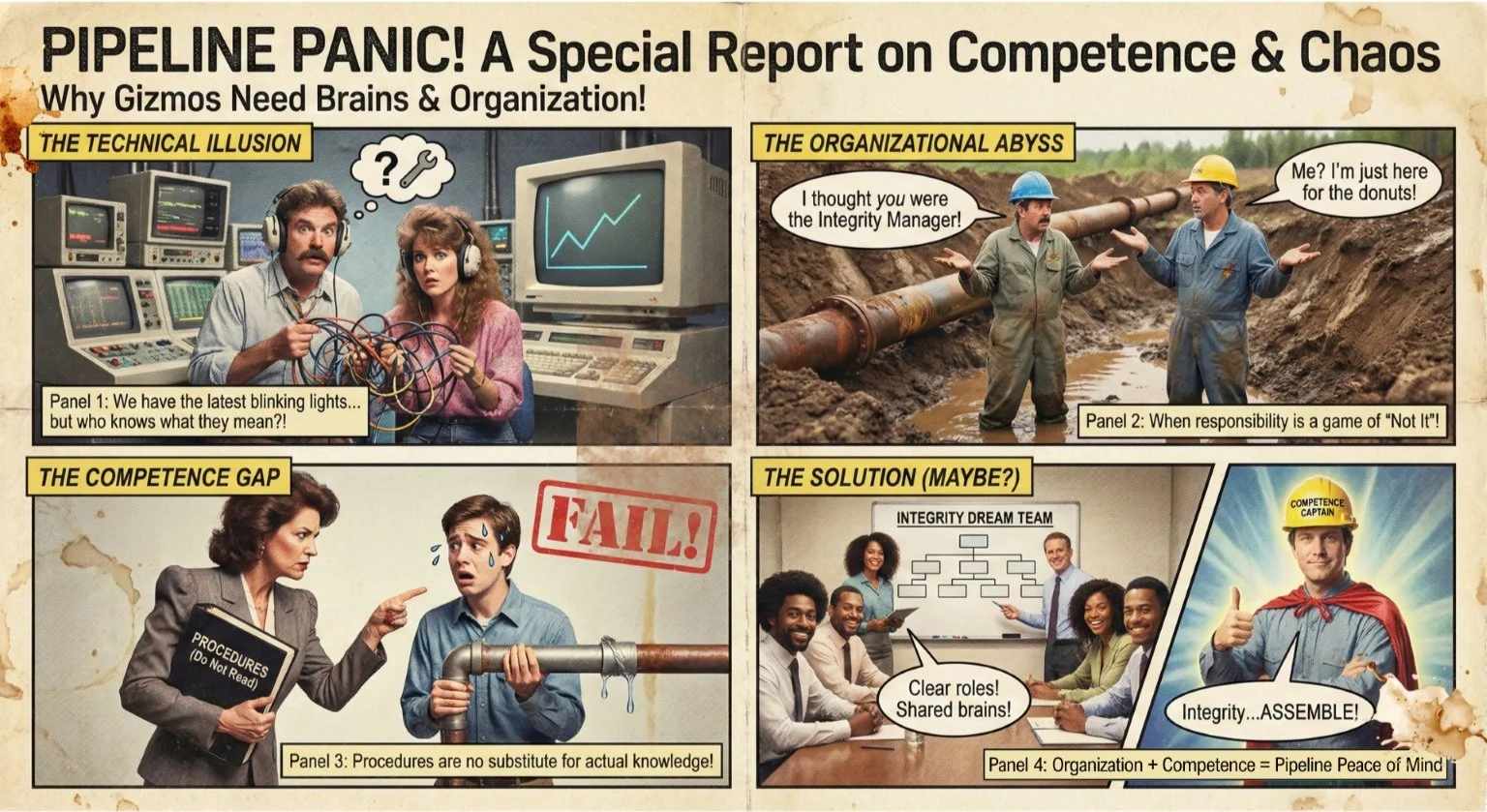
Pipeline Panic!
Integrity management is a socio-technical system
Pipeline integrity is not managed by technology alone. It is managed by people who:
interpret inspection and monitoring data,
make operational decisions,
assess risk and uncertainty,
authorize continued operation or repairs.
Without adequate competence and clear accountability, even the most sophisticated integrity tools become ineffective.
Why technical expertise alone is not sufficient
Integrity decisions often sit at the intersection of engineering, operations, and maintenance. Pure technical expertise, without understanding operational constraints, leads to:
unrealistic integrity recommendations,
misalignment with day-to-day operations,
erosion of trust between teams.
Conversely, operational decisions taken without integrity expertise frequently invalidate corrosion and degradation assumptions.
Clear roles and responsibilities reduce integrity gaps
Many integrity failures occur in environments where:
responsibility for integrity decisions is unclear,
multiple teams assume others are managing integrity,
escalation paths are undefined.
A robust integrity management system requires:
a clearly identified integrity authority,
defined decision rights,
unambiguous accountability for risk acceptance.
Ambiguity in organization is itself an integrity threat.
Competence directly affects integrity decisions
Competence in integrity management extends beyond academic knowledge. It includes:
experience interpreting inspection uncertainties,
understanding degradation mechanisms,
ability to challenge assumptions and vendor outputs,
judgment under uncertainty.
When competence is insufficient, integrity decisions tend to rely excessively on rules, software outputs, or historical practices.
Why governance matters as much as inspection
Integrity governance ensures that:
integrity-related decisions are made at the appropriate level,
deviations are formally assessed and documented,
integrity constraints are enforceable within operations.
Without governance, integrity becomes advisory rather than authoritative.
How international standards address competence and organization
Only a limited number of standards explicitly address competence and organizational aspects of integrity:
API RP 1160 requires operators to define responsibilities, authority, and competence for integrity management activities.
ISO 55001 (Asset Management) emphasizes organizational roles, competence, and governance as prerequisites for effective risk management.
DNV-RP-F116 highlights the importance of organizational processes and human factors in maintaining pipeline integrity, particularly in complex systems.
These standards recognize that integrity is as much about governance as it is about engineering.
The risk of over-reliance on procedures
Procedures are necessary, but they do not replace competence. Over-reliance on procedures often leads to:
mechanical execution without critical thinking,
inability to manage unexpected conditions,
delayed recognition of emerging threats.
Competence allows procedures to be applied intelligently rather than blindly.
Integrating competence into integrity management
Effective integrity management integrates competence by:
defining minimum competency requirements,
providing continuous training aligned with operating reality,
encouraging cross-functional collaboration,
empowering integrity roles to challenge operational decisions when required.
Conclusion
Pipeline integrity management cannot be reduced to inspections and calculations. It depends fundamentally on competent people, clear organization, and strong governance. Pipelines rarely fail because inspection technologies are inadequate. They fail because integrity decisions are made without sufficient competence, authority, or organizational clarity.