
Why Corrosion Allowance Alone Is Not a Corrosion Management Strategy
Corrosion allowance is a fundamental concept in pipeline design. By adding extra wall thickness, designers account for expected metal loss over the life of the pipeline. This approach is well understood and widely applied across the oil and gas industry.
However, corrosion allowance is often mistakenly treated as a corrosion management strategy, rather than what it truly is: a design margin. This misunderstanding is a recurring root cause of integrity issues, particularly in ageing pipelines and mature fields.
This article explains why corrosion allowance alone is insufficient to manage corrosion risk and how integrity management must go beyond thickness margins.
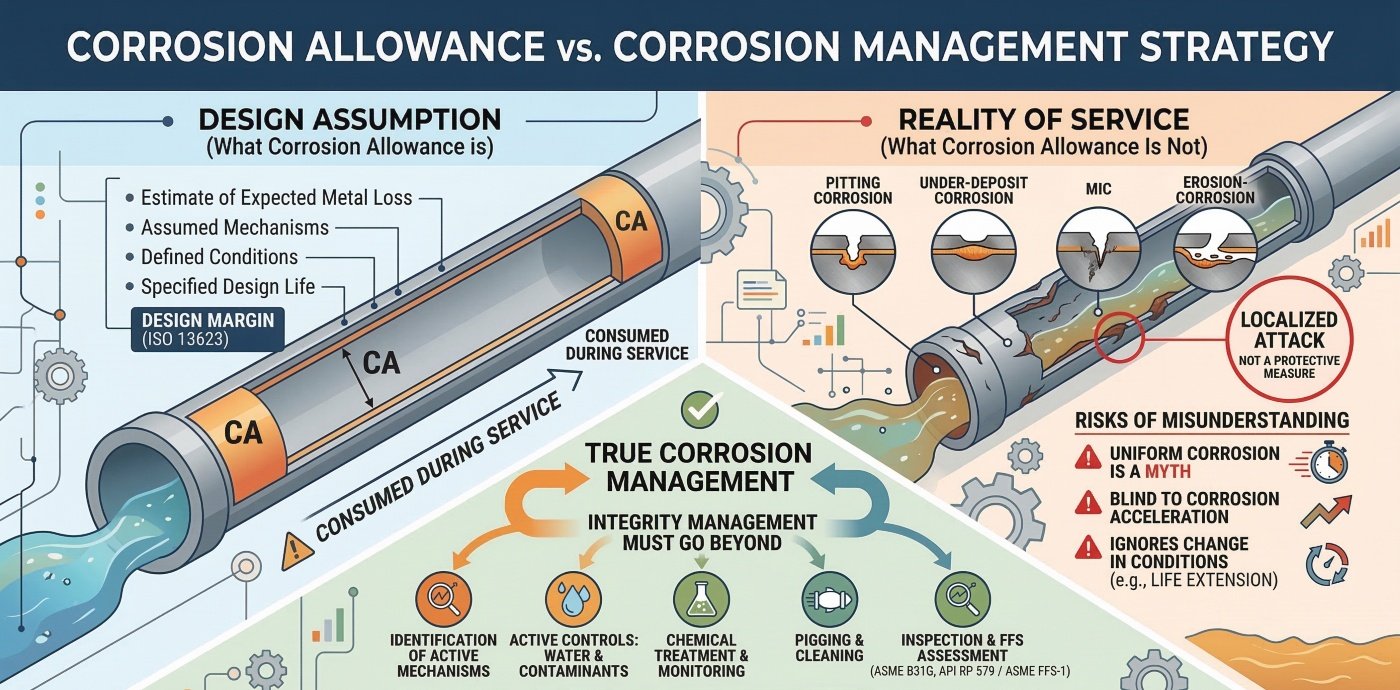
Corrosion allowance vs Corrosion management
Corrosion allowance is an initial design assumption. It represents:
an estimate of expected metal loss,
based on assumed corrosion mechanisms,
under defined operating conditions,
over a specified design life.
Standards such as ISO 13623 clearly define corrosion allowance as part of pipeline design, not as an operational mitigation measure. Once the pipeline is in service, corrosion allowance is continuously consumed.
Adding wall thickness does not change:
the presence of free water,
the fluid chemistry,
the flow regime,
the corrosion mechanism.
Corrosion allowance merely delays failure. It does not reduce corrosion rates, nor does it prevent localized attack. Treating corrosion allowance as a protective measure often leads to delayed mitigation and underestimated risk.
Corrosion allowance is inherently based on uniform corrosion assumptions. In practice, many pipelines experience:
pitting corrosion,
under-deposit corrosion,
MIC,
erosion–corrosion.
In these cases, metal loss is concentrated in small areas, rapidly consuming the local wall thickness regardless of the global corrosion allowance. Fitness-for-service methodologies such as ASME B31G and API RP 579 / ASME FFS-1 explicitly distinguish between generalized corrosion and localized damage, highlighting that corrosion allowance concepts are not sufficient for localized mechanisms.
Corrosion allowance is blind to corrosion rate acceleration as it assumes relatively stable corrosion rates. It provides no protection against:
sudden water breakthrough,
changes in flow regime,
oxygen ingress,
loss of chemical inhibition.
When corrosion rates accelerate, corrosion allowance may be consumed far faster than anticipated, often without early warning if monitoring is inadequate.
Many pipelines operate far beyond their original design life or under conditions significantly different from those assumed at design stage. Corrosion allowance does not automatically adapt to:
life extension decisions,
repurposing of pipelines,
changes in transported fluids,
new operating envelopes.
Integrity management must explicitly reassess corrosion risks when design assumptions are no longer valid.
From an integrity management perspective, corrosion allowance provides no guidance on:
inspection intervals,
monitoring strategy,
mitigation effectiveness,
remaining life uncertainty.
Integrity decisions must be based on actual condition and degradation behavior, not on unused thickness margins.
Corrosion management requires active controls
Effective corrosion management integrates:
identification of active corrosion mechanisms,
control of water and contaminants,
chemical treatment and monitoring,
pigging and cleaning programs,
inspection and fitness-for-service assessment.
Corrosion allowance may provide time to implement these measures, but it cannot replace them.
Only a limited number of standards explicitly clarify the role and limitations of corrosion allowance:
ISO 13623 treats corrosion allowance as a design parameter that must be complemented by operational corrosion control measures.
ASME B31G and API RP 579 / ASME FFS-1 focus on assessing remaining strength once corrosion has occurred, not on relying on unused corrosion allowance as protection.
These standards consistently separate design margin from integrity management.
Corrosion allowance is a necessary design tool, but it is not a corrosion management strategy. Pipelines rarely fail because corrosion allowance was insufficient at design stage. They fail because corrosion allowance was relied upon instead of actively managing corrosion mechanisms. Understanding this distinction is essential for effective pipeline integrity management, particularly in ageing and repurposed assets.