
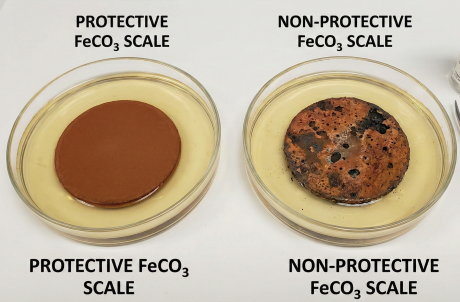
When Iron Carbonate (FeCO₃) Becomes Protective… and When It Does Not
This article explains when iron carbonate becomes protective, when it does not, and why integrity assessments frequently overestimate its effectiveness.
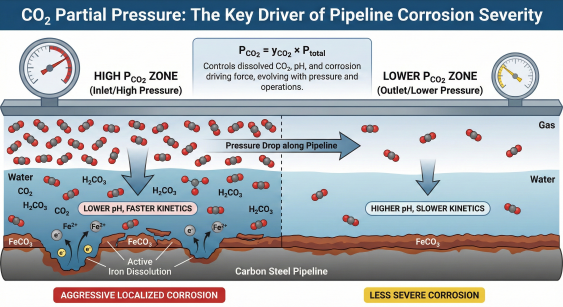
Why CO₂ Partial Pressure Is the Key Parameter for Corrosion Assessment in Carbon Steel Pipelines
This article explains why CO₂ partial pressure is the governing parameter for CO₂ corrosion and how it should be correctly used in integrity and maintenance decision-making.
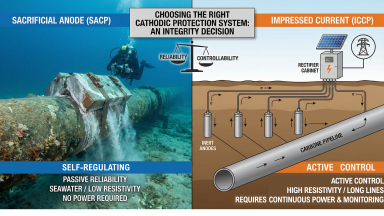
Sacrificial Anodes vs Impressed Current: How to Choose the Right Cathodic Protection System
This article explains how integrity engineers should choose between sacrificial anodes and impressed current systems, based on asset characteristics, operating environment, and lifecycle considerations.
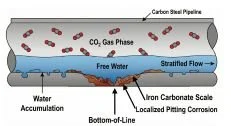
How CO₂ Causes Corrosion in Carbon Steel Pipelines
CO₂ corrosion, often referred to as sweet corrosion, is one of the most common internal corrosion mechanisms affecting carbon steel pipelines in the oil and gas industry. Despite being widely studied and relatively well understood, CO₂ corrosion remains a frequent cause of unexpected pipeline degradation and failures.
The root cause is not a lack of knowledge, but a simplified understanding of how CO₂ actually leads to corrosion under real operating conditions. This article explains the fundamental mechanism of CO₂ corrosion in carbon steel pipelines and why its severity is often underestimated in integrity management.
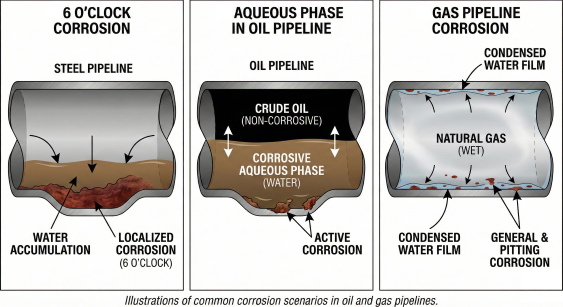
Why Pipelines Only Corrode When Free Water Is Present
One of the most fundamental principles of pipeline corrosion is also one of the most misunderstood: pipelines do not corrode without free water.
This article explains why free water is the true enabler of pipeline corrosion and why managing water is central to pipeline integrity management.
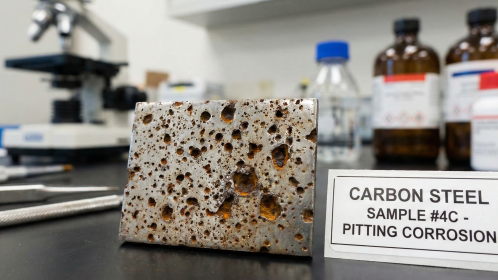
How to Correctly Identify Internal Corrosion Mechanisms in Pipelines
Correct identification of corrosion mechanisms is essential. Treating CO₂ corrosion as MIC, or erosion-corrosion as pure corrosion, leads to ineffective mitigation.
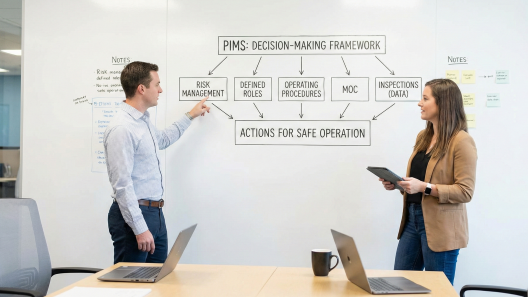
What Does a Pipeline Integrity Management System Really Include Beyond Inspections?
In many organizations, Pipeline Integrity Management Systems (PIMS) are still perceived as a combination of periodic inspections, in-line inspections (ILI), and leak detection systems. While these elements are essential, they represent only a fraction of what an effective PIMS must deliver.